

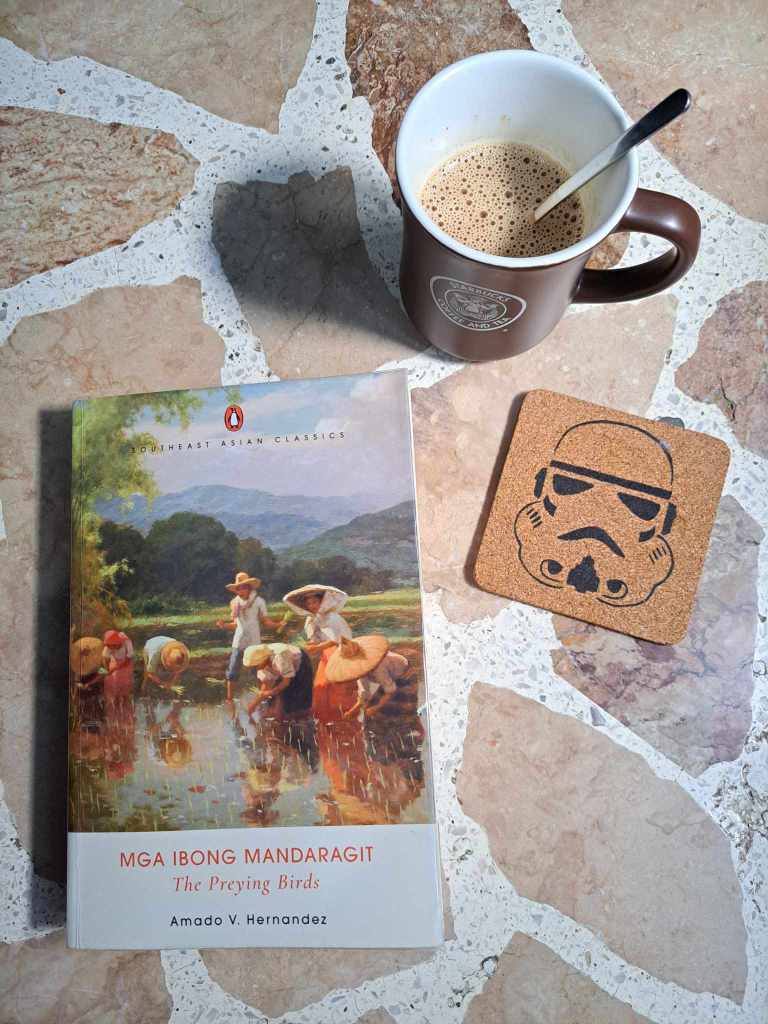
Now that THE PREYING BIRDS (Mga Ibong Mandaragit) by Amado V. Hernandez has been translated into English by Danton Remoto for Penguin Random House SEA in 2022, this reader finally got the chance to read a book I’ve been hearing about for so long, by an author recognized as a National Artist for Literature.
What if Ibarra/Simoun’s treasure was real, and what if it was found at the close of World War II?
Hernandez wrote this in prison in the 1960’s, and it’s pretty much the continuation of Noli Me Tangere and El Filibusterismo, the two novels by Jose Rizal that shaped the destiny of the Philippines.
What breaks my heart with anger and sadness is how contemporary it all feels. Yes, the sexism and jokes of a very macho culture date the text, and the way he describes women would have him cancelled if he wrote this today, but the central themes still persist even sixty years later. It truly feels like reading a very long series of newspaper headlines from 2024. Persecution of anyone who dares point out unfair practices. Graft and corruption. Rallies dispersed violently. Morally suspect and lazy politicians who come at 12:30 to 9:00 am Senate hearings. Church leaders who preach one thing but frequent poker tables with snacks like lechon and sherry or brandy.
The title refers to birds of prey who feed on carcasses. Hernandez shows in this novel that the rotting, starving corpse is the Philippines, and the ones who got fat on us changed over the years. Various colonizers came and went, but the powerful and rich fellow Filipinos got fatter and richer and seemingly are here to stay.
Hernandez writes with the fire of a political prisoner, doing a Rizal. The influence is so strong, he quotes his Noli and Fili several times, and even his protagonist combines the characteristics of Rizal and Bonifacio: the idealist’s brain merged with the decisive action of a fighter.
Decades from now, foreigners can read this book after Rizal’s duology and recognize the commonalities: the no-holds-barred depiction of every avarice and cruelty experienced by the author in real life, the exhortations for Filipinos to fight the worst of our traits and seek to better ourselves through education and moral reform, and the generations-long battle to form that rare jewel: a responsible citizen who doesn’t seek to flee to America at the first opportunity, but understands that s/he has duties and responsibilities to the country’s future, paid for by martyrs past.
While not always enjoyable (because sometimes it’s plain tiring to read and alternate between despair and hope), it is truly an important work.
As a teacher, I find hope in the strategy that Amado V. Hernandez’s main protagonist, Mando Plaridel, adopts as a gameplan.
Build a good school that will form responsible citizens dedicated to nation building.
Establish a newspaper, then radio and TV stations (they didn’t have the internet back then) to help mould national consciousness by reporting truth without fear, shining light on dark, corrupt practices.
And of course, land reform that benefits the poorest and not the richest.
The book is a prayer of sorts. It’s an idealist’s invocation in novel form, hoping that receptive minds and younger, stronger hearts read it and, hopefully, bring about the change that takes generations to carve out.
~ ~ ~ ~ ~
~Written by Gabriela Francisco
(Gabi Francisco (@teacher.gabi.reads)
[The reviewer bought the Southeast Asian Classics edition of MGA IBONG MANDARAGIT / THE PREYING BIRDS from Fully Booked for P1,482.00.
The same edition is available in National Bookstore for P1,075.00.]
 Ex Libris Philippines