
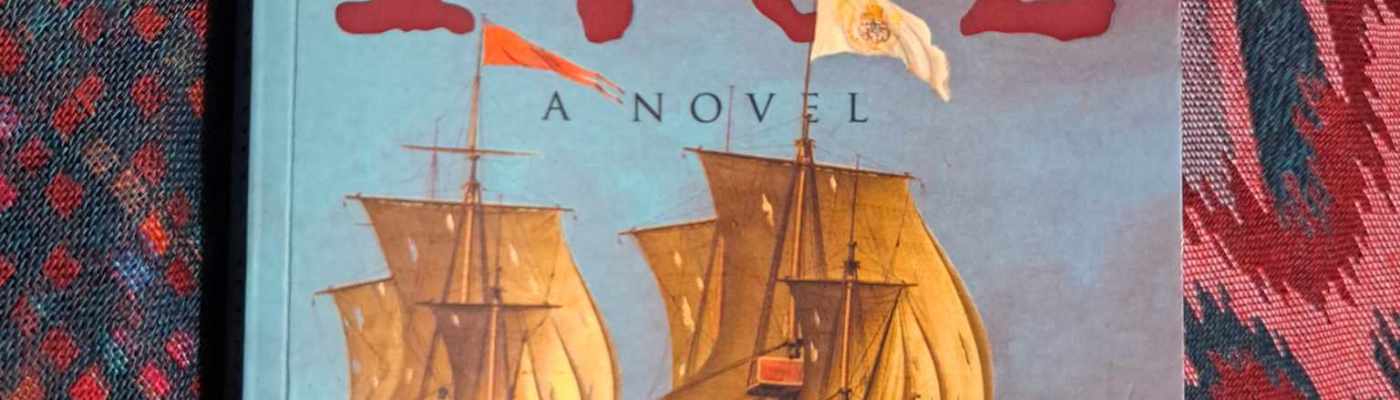

“Why is it that we all share a single vision, but no one knows how to get there?”
“How can we know? We do not even have an idea who we are.”
Vin dela Serna Lopez’s historical novel 1762 seems bowed down by the weight of its author’s baroque prose. Throughout the entire novel, this reader found herself wondering who was the intended audience for this work. While admirable for its pioneering venture into a relatively unknown topic, as well as its’ six-year gestation, it makes enormous demands on the casual lay reader.
When readers think of a Filipino historical fiction book, more often than not, it is set in one of two (or three) conflicts that continues to define our present: the Philippine Revolution against Spain or America (like Linda Ty-Casper’s “The Three-Cornered Sun”), and the Japanese Occupation during World War II (like Wilfrido Noledo’s “But For the Lovers”).
So when this novel was published by Ateneo University Press last year (and won a Special Prize from the Palancas, to boot), my bookish friends and I bought copies upon reading its interesting summary. After all, this may very well be the first time a Filipino novelist has written of that time in our colonial past when we nearly became a British colony.
Drawing on extensive research by our foremost historians, Lopez brings the reader to Manila and Cavite just when British ships sail in and conquer Intramuros. The rape and plunder, as well as the savagery with which Filipinos fought back under the Spanish flag, are illustrated, with helpful maps in the beginning of the book proving handy. But also, Lopez shows, the presence of a third party was a match lighting a fire to a powder keg of indios bristling under unjust Spanish tyranny.
Perhaps the most interesting chapter was the fourth (entitled “Motto Stella,” which is also the name of the Rizal Monument, fittingly called “Guiding Star”), when a female character steps into a library of the future and overhears a learned discussion by Amado (V. Hernandez?) and Nicomedes (Nick Joaquin?) about Philippine history, up to two hundred years from the events in the book. Genuinely moving, it introduces the figure of Jose Rizal in the book, and until the very end, his phantom literally and figuratively haunts the pages. Chapter 4 is the author at his most hopeful and radiant, and its existence alone justifies purchasing the book.
This is Lopez’s first novel, as his previous awards were won for his poetry. Perhaps this makes his rhapsodic descriptions more understandable, as he allots an entire page on a hallway here, a street there. But to this reviewer’s utter dismay, the same attention to detail was spent on explicitly describing two separate acts of sexual assault, separated by a mere twenty-two pages. Lengthy poetic descriptions aside, rape is rape, and was extremely unpleasant for this reviewer to get through. There was almost a relishing to the writing, that made this reader wish for a bit more sympathy from the author towards a female symbol-as-character. While there is a long tradition for female characters as metaphors for the ravaged Motherland, the execution seems excessive and leads the reader to wonder at its true purpose.
Another obstacle that prevented me from getting lost into the narrative flow was the use of so many unfamiliar words, not just comprehensible time-specific jargon that all historical novels need for verisimilitude, but the numerous quotes in Spanish or Latin ranging from the brief “valle lacrimum” to entire lines from Rizal’s death poem. Such artistic choices may alienate readers who aren’t familiar with Mi último adiós or the Roman rite.
There is an artificiality of sorts to the language, a consciousness to a tale told by an author using characters rather coldly, seemingly as mere symbols, and not helped by the mostly stilted dialogue.
(“You know what? We may all be Orpheus in one form or another. Love forces us to challenge rules. Imagine dying for such fiction.” “But isn’t (it) love, too?” “We differ in our understanding of love, but feeling is a universal rule, not some human construct. Man-made ideas are based purely, of course, on knowledge. Those that apply for all eternity transcends it. Truth is something that has to be lived, not something that has to be known.”)
In terms of writing characters as symbols, Nolledo does something similar in “But For the Lovers,” with his Filipina and his Spaniard, but he manages to imbue them with humanity all the same. We care for them as people despite seeing how they are much more than their characters. Sadly, this is not the case with Lopez’s book.
This reader ended 1762 thinking it was written to show that the self-destructive patterns in Filipino culture and thinking were present then, as it was in the beginning, as it is now and ever shall be. And if it is a prayer that this world will end, it did not come across. The tone is bleak, the gaze on the horizon furious and seeing dark portents.
“Do people who keep looking for a tormentor ever deserve to call themselves a nation?”
This book is recommended for readers who enjoy Gina Apostol and other similar, scholarly works, as well as for readers who wish to stretch their literary horizons to the fullest. Lopez is to be commended for this admirable undertaking. This reader hopes the author considers writing future books that will be appreciated by more readers, as this first novel clearly shows that he has stories worth telling. This reader hopes he tells them well.
ABOUT THE REVIEWER:
Gabi Francisco is a classically trained soprano who now performs in the English / Music / Drama classroom. On weekends she soaks in as much art and literature as she can, so she can pass her love for the arts on to her students. She passionately believes in the transformative role of arts education in nation-building. (IG: teacher.gabi.reads )
[The reviewer bought 1762 from Ateneo University Press for P500.00]
 Ex Libris Philippines