
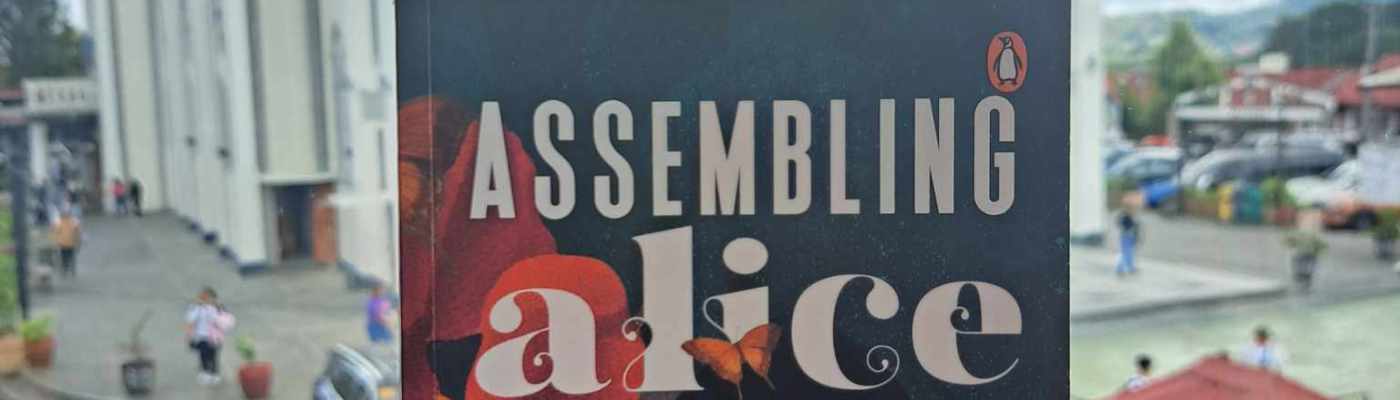

It’s always a thrill when an author signs a copy of her book, leaving an imprint of ink that will outlive her. It’s never just a signature; it’s a magical piece of an immortal soul.
When Mookie Katigbak-Lacuesta signed my copy, she wrote: “Hope you enjoy this glimpse into our history.”
When seen against the background of 333 years of Spanish rule, the three-year Japanese occupation of Manila during World War II may seem like a mere glimpse indeed. But it echoes still in our collective history, a trauma that forms the core of this book.
It is written in fragments, with chapters in the first person showing how characters were connected to Alice Feria, a pianist who experienced the greatest tragedy possible during the war, and yet survived to become a journalist afterwards (she published The Filipino Home Companion).
I made sure to put off reading it until I was in Baguio, where the book opens with a Japanese gardener in 1939 coming to take care of a wealthy Filipino’s roses.
This is not a tidy tale, as chapters jump from decade to decade, from character to character. But then, real life is never tidy. Nor is it fairylike, despite it being historical fiction. This is a tale of survival, not just of one woman, but of a people and their struggle to remain civilized and human despite the worst brutalities war brings.
Not all poets make the transition to prose successfully, but Mookie Katigbak-Lacuesta made it seem effortless. The poet can be heard in her beautifully constructed sentences, which one reads with pleasure before the full meaning hits you, with its variations of tragedy and mirth.
Katigbak-Lacuesta the poet/prose artist’s skill was particularly enjoyable in the chapter where Alice tries to supply the missing third line in the Japanese gardener’s haiku. Before reading this book, I had no idea what kijo/kigo and kireji were. Now I shall never forget, especially with the beauty of this excerpt:
“All at once she is my kijo and kireji, and whatever sublime marriage they can make of themselves in the last line. Alice reconciles all my aspects to my one self. Alice is my third line.”
Musicians and artists will enjoy the references to the Manila Metropolitan Theatre in its heyday in the 1940’s, and the Manila Symphony Orchestra, with Dachau and Buchenwald survivor Herbert Zipper, its conductor, being one of the characters.
“When Zipper arrives at the Manila Metropolitan Theatre and sees it for the first time, he looks at the edifice the way one would remember a first love – how the story moves from glance to touch, from thrill to love; how the present embellishes the past with stepped gables and minarets. But he also sees how the past is native and peculiar to its person. How despite style, there is also substance… Zipper understands that the Manila Metropolitan Theatre might be one of the truest expressions of national love.”
Admittedly, there were a few times that the poetic metaphor seemed a bit too stretched for credulity. Like when the neighbor brings news about Pearl Harbor’s bombing, and her husband says, “The sounds sounded like some kind of doom music – that Manila was a piece awaiting its name and that the music was happening elsewhere. I asked Alice to name the music as though it were a symphony… It was clear Alice was composing the battle sounds into a kind of crazed music in her mind.” It seems an unlikely knee-jerk reaction to news of impending war. But over-all, this reviewer will remember the writing for its singing music.
What use is one life, when so many live and die? This book proffers an answer: very little, or the entire universe, depending on who does the remembering.
There is another excerpt that perhaps sheds light on the why behind the book: “I would like to believe that I am living my father’s dream. He continues through me, and whatever I make of my life. Through me, he cannot die.”
Through this exquisite remembering of a grandmother whom she never knew, Katigbak-Lacuesta has written a “literary biography” that preserves not just her person, but the era that made her.
~Written by Gabriela Francisco
(Gabi Francisco (@teacher.gabi.reads)
[The reviewer bought ASSEMBLING ALICE from Fully Booked for P1,199.00. The same book is also available from National Bookstore for P1,100.00]
 Ex Libris Philippines