“Even God can be felt in the heat of the sun or the bliss of the ocean. But what happens to your crypto when the circuits or blockchains are broken? What happens when the power goes out?”
Sci-fi books are scarily prophetic. From the modern physics-defying vehicles and gadgets we take for granted, to the way each and every person is plugged into a global source of information… all these have been predicted in one way or another by a sci-fi author in the past. But the best sci-fi also describe all that’s gone wrong in our world, making us aware of society’s ills that have become invisible through overfamiliarity.
Marga Ortigas now turns to this incredibly powerful genre as she shifts gears in her latest book, which is so different from her previous ones (The House on Calle Sombra and There are No Falling Stars in China). She follows sci-fi’s long literary tradition of righting today’s wrongs by writing about a frighteningly possible tomorrow.
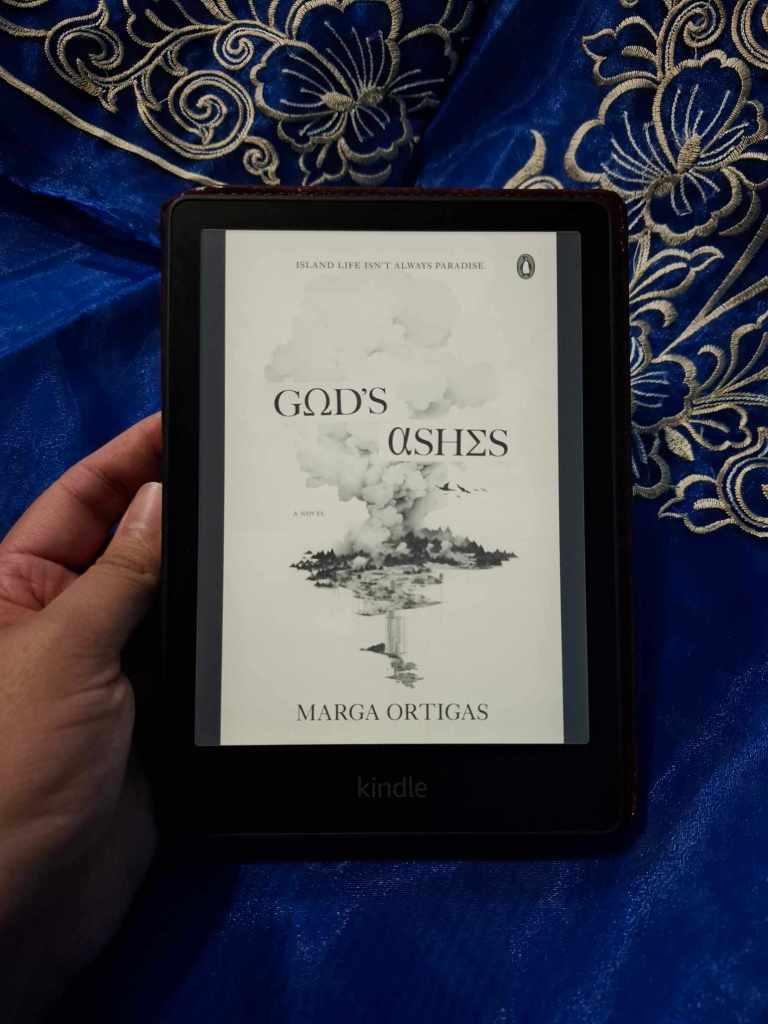
God’s Ashes takes place in the not-too-distant future, when humans are implanted with superchips that turn us into computers and batteries, connected to everything and everyone. Ortigas shows the dangers of what that much power does, while showing the threats to the natural world and the risks to the morality of humanity. Reading certain parts of the book felt like watching the film Oppenheimer, because of the dawning horror that this is a plausible Armageddon in the making. And we are just letting it happen.
It was in this book that I first realized the extent of the damage of “The Day of Two Suns.” Ortigas writes that the Marshallese (inhabitants of the Marshall Islands, between Hawaii and Manila) remember the day “when a man-made ball of light decimated their environment… and so they stood aside while the US bombed their home, testing nuke after nuke, for the next ten years. Entire islands were vaporized and turned into craters. Almost half a century later, they were still suffering the fallout.” Ortigas then describes the real concrete dome called The Tomb, where the US buried the toxic tonnage on Runit Island and left a legacy of cancers across generations.
While the scope of the novel is breathtakingly vast – with settings as varied as London and Manila, Sabah and Kazakhstan – and the narrative threads attempting to weave together technology, math, and philosophy (so much for so slim a volume!), a longer novel would perhaps have made a smoother, more cohesive whole.
This reader felt that the book’s language was superficial and too abrupt at times, especially in the portions that required technical language. The characters were so many, and time spent with them rather too short for this reader to care more deeply for them. The dialogue also seemed rushed, and rather on-the-nose, telling us how something works rather perfunctorily, instead of showing us through more illustrative prose.
The tone necessary to simplify Euler’s equation, for instance, is a jarring shift from when Ortigas writes poetically of the Thames (“Its silence had the textures of symphonies and the winged creatures carried the expanse of their dreams.”) The novel is at its best when Ortigas describes places she cares deeply about.
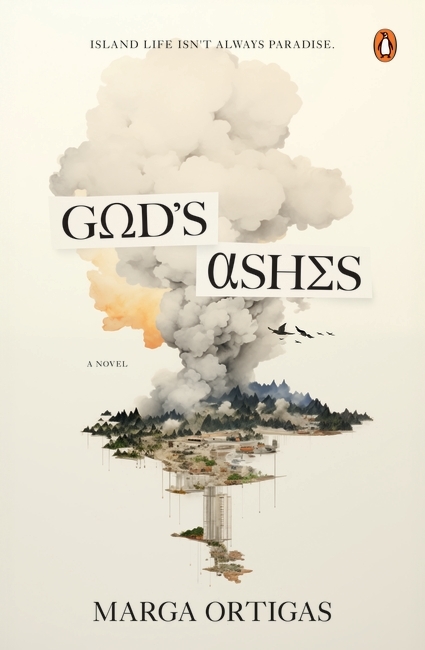
(Image from penguin.com.au)
God’s Ashes, then, is defamiliarization with a mission. A highlight of reading Ortigas is the education her books offer, with her journalist’s viewpoint: global, all-encompassing, and brimming with urgency to describe an all too familiar world, using fiction to highlight important stories that are all too real, and all the more scary. This reader gets the impression that Ortigas writes to change the world, and that is always worthy of praise.
~Images and text by Gabriela Francisco
(Gabi Francisco (@teacher.gabi.reads)
[An ARC was sent to the reviewer. The paperback is available from Fully Booked for P750.00 and from Amazon as a Kindle ebook for P566.98]
 Ex Libris Philippines