
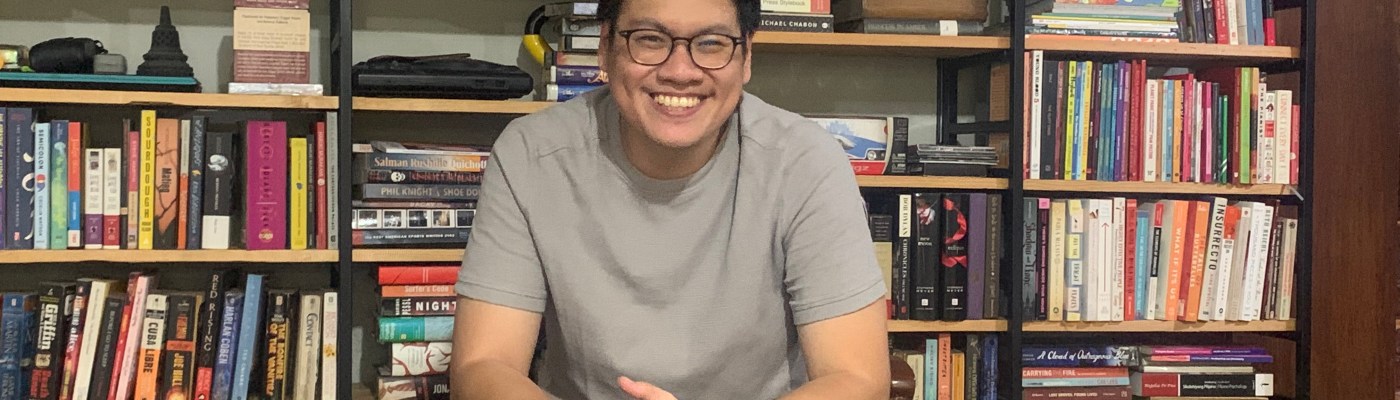
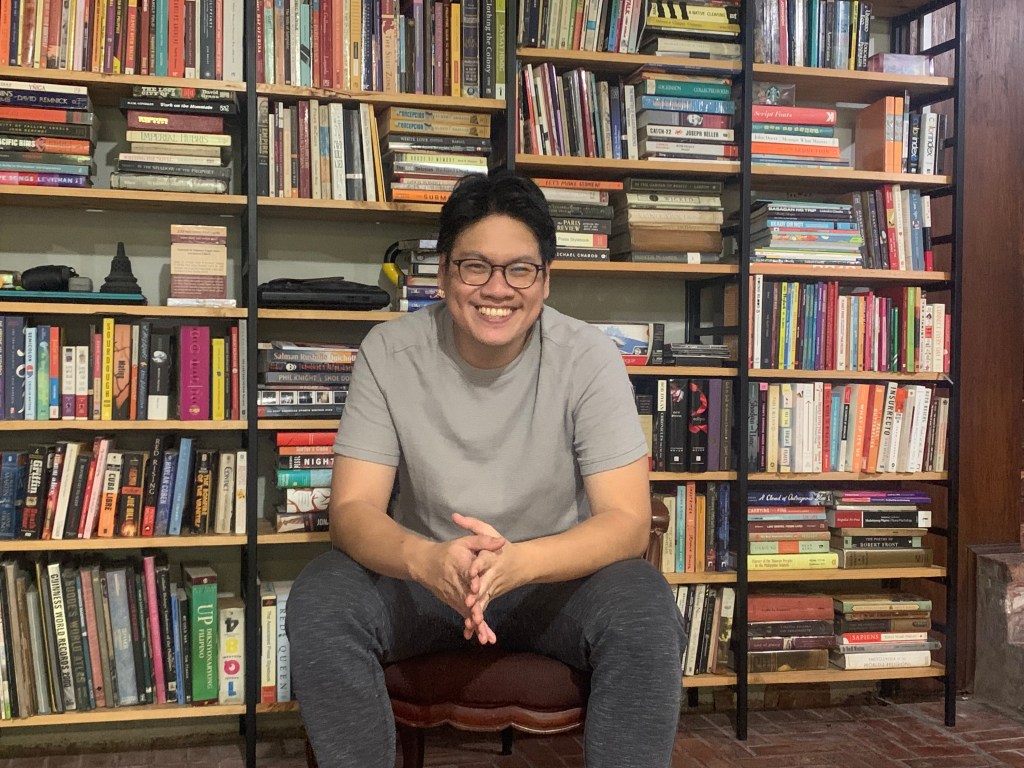
Author/podcaster/editor Lio Mangubat doesn’t make a habit of throwing things away, not old VHS tapes from his childhood, and certainly not the contents of his personal library. There is rhyme and reason behind his hoarding.
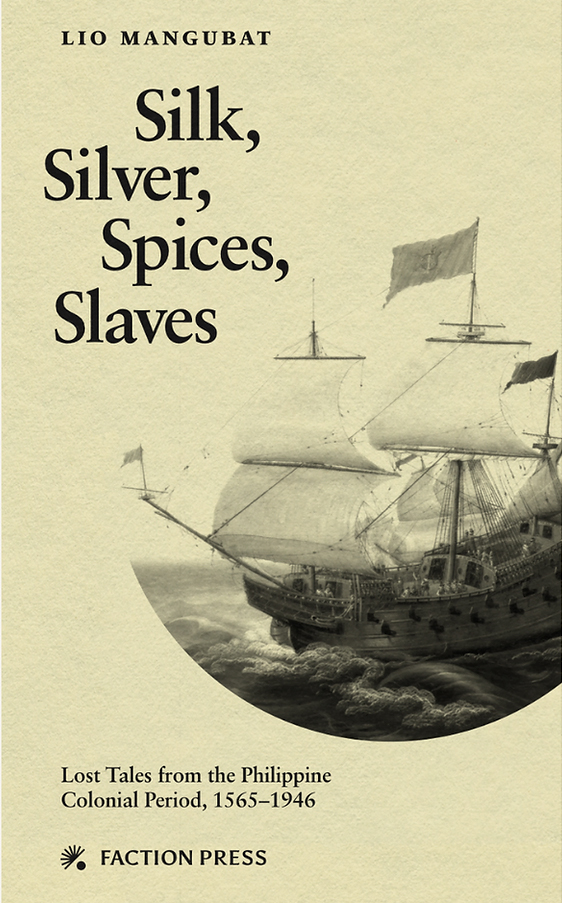
Some of the author of Silk, Silver, Spices, Slaves‘ prized possessions include a 1988 issue of National Geographic with a special holographic cover, and the books he inherited from his late uncle, a history professor and the subject of his new book’s most personal essay, “The Professor and the Book.”
At a glance, the bulk of Mangubat’s current collection appears to be nonfiction, most of which are on (or adjacent to) Philippine history—from Albert Samaha’s Concepcion, which Mangubat devoured in one night, to Stephanie Coo’s Clothing the Colony, whose spine bears evidence of regular use. Some of these books were gifts from friends and family. His wife, MM, once gave him a number of local nonfiction titles tantamount to a mini library. Others were found at the many book fairs that Mangubat has attended over the years as a book editor.
“Every time there’s MIBF or the Philippine Book Festival, I would always drop by Ateneo, UP, UST, and whatever is interesting there, I’d pick up one or two titles,” he says.
Despite the enviable number of titles on his shelf, the author reveals that he wasn’t always such an enthusiastic reader of local history. Growing up, he was more interested in Vikings, the Middle Ages, and World War II. It was only in 2017, upon picking up a rogue copy of When Britain Ruled the Philippines 1762–1764 at home, that he began to realize just how much more exciting Philippine history could get.
The book, written by Shirley Fish, led Mangubat to write his first article about Philippine history for Esquire Philippines. It was published in three parts, like a serial in a 19th-century periodical. In 2021, in between periods of lockdown, he had the idea to release more of these stories in a narrative podcast, which he called The Colonial Dept.
“It was a passion project that also felt like an interesting creative challenge,” says Mangubat. “I’d always considered myself as a writer, but how could I tell these stories as audio experiences? I set a goal of writing, narrating, engineering, and publishing a main episode every two weeks, and see how far I could take the project.”
Anya Reyes, a frequent contributor who provides voice-overs for the podcast, has seen firsthand the amount of work Mangubat puts into it. “It’s not as simple as hitting the record button and talking,” she says. “There’s research, scriptwriting and editing, assigning parts to me, then editing several layers of speech, background music, and other elements to make one robust-sounding and interesting episode.”
It’s the research part that is the most critical and laborious, not to mention unpredictable (although, from the excitement in Mangubat’s voice, it sounds as if he wouldn’t have it any other way). “I think that sense of discovery was what drew me into writing about history in the first place,” Mangubat explains.
His Esquire essay about Jeoly, the Mindanaoan slave whose skin was displayed at Oxford, is the perfect example. “I saw that in a book about a map of China,” Mangubat says. “It was one of those side stories, and I said to myself, ‘This is such an interesting story that’s Philippine-adjacent.’ It’s such an interesting story of cruelty in the name of science, so I spun that off into a wider article.”
While corroborating his piece, Mangubat found an unexpected link and another layer to the story. One of Jeoly’s masters, an English buccaneer named William Dampier, turned out to be one of the inspirations for the classic novel Robinson Crusoe.
“I think that’s what kicks off an idea, [the thought that] all of these things are interconnected, and it’s so fun for me to connect those dots, to make the jumps from one book to another and try to bring them into this more coherent story,” he explains.
Despite the amount of acrobatics he does, Mangubat is quick to dismiss the notion that he’s doing any sort of detective work. “I’m just really pulling from books that other people have written,” he says. “I’m just building off what they do—these professional historians.”
He adds that the topics he chooses are not undiscovered. “I’m not claiming to be the first one to talk about it, but to help introduce it in a fun way, I think, is my goal.”
His listeners, half of which are around 28 to 44 years old, aren’t the only ones who appreciate his hard work.
In 2023, Faction Press founder Chye Shu Wen got wind of the podcast through Stephanie Shi, a community manager at SEA Lit Circle with whom the Singaporean publishing house shared the goal of spotlighting voices in the region.
“Shu Wen was particularly interested in publishing exclusively nonfiction books, and if I recall correctly, she was open to works that took different formats and explored overlooked histories,” says Shi. Pitching Mangubat’s podcast was only natural.
Shi adds, “I was a fan of Lio’s project for some time at that point, and I respect and admire Lio’s approach to history: he’s humble and open-minded, he’s not judgmental, on top of being passionate and engaging.”
While working on his own book hadn’t been on Mangubat’s bingo card that year, the opportunity was too good to pass up. “I would have been happy if it had just stayed a podcast,” he says. “I was always happy to think of it as just a side project that I would do. The book was just, as BINI puts it, ‘cherry on top.’”
The original proposal for Silk, Silver, Spices, Slaves was to make it chronological and to arrange it by theme, but Mangubat had a very clear vision of how he wanted the book to be read. “I wanted to stick to how I do the podcast, which is the feeling of jumping through time,” he explains. “It’s very nonlinear. I wanted to have that feeling of suddenly you’re in a different world every time you go to the next chapter or go to the next episode.”
His 14-year-old self, the audience Mangubat had in mind while writing the book, would have probably enjoyed the ride.
Mangubat’s podcast just started its sixth season in early August, and his book will soon have its Philippine launch on August 31 at Everything’s Fine in Makati.
While there’s a lot to be learned from both, perhaps the most important lesson here has less to do with history and more to do with life.
Mangubat pursues his passion for knowledge with an excitement that is as contagious as it is genuine. He follows his heart wherever it leads him, and if that means making more space in his home for his precious books or having to dust his custom shelf with increasing regularity, well, it’s a small price to pay to be surrounded by what he loves.
Click here for Lio Mangubat’s book recos!
Click here for our review of SILK, SILVER, SPICES, SLAVES.
~ ~ ~
Photos and text by Jen Chan
ABOUT THE AUTHOR:

Jen Chan has spent more than a decade writing and editing for various lifestyle websites and magazines in the Philippines, but her first love has always been fiction. Her work has been shortlisted in Oxford Flash Fiction and Women on Writing. She lives in Manila with her cat Dansk and three of her kittens.
 Ex Libris Philippines