

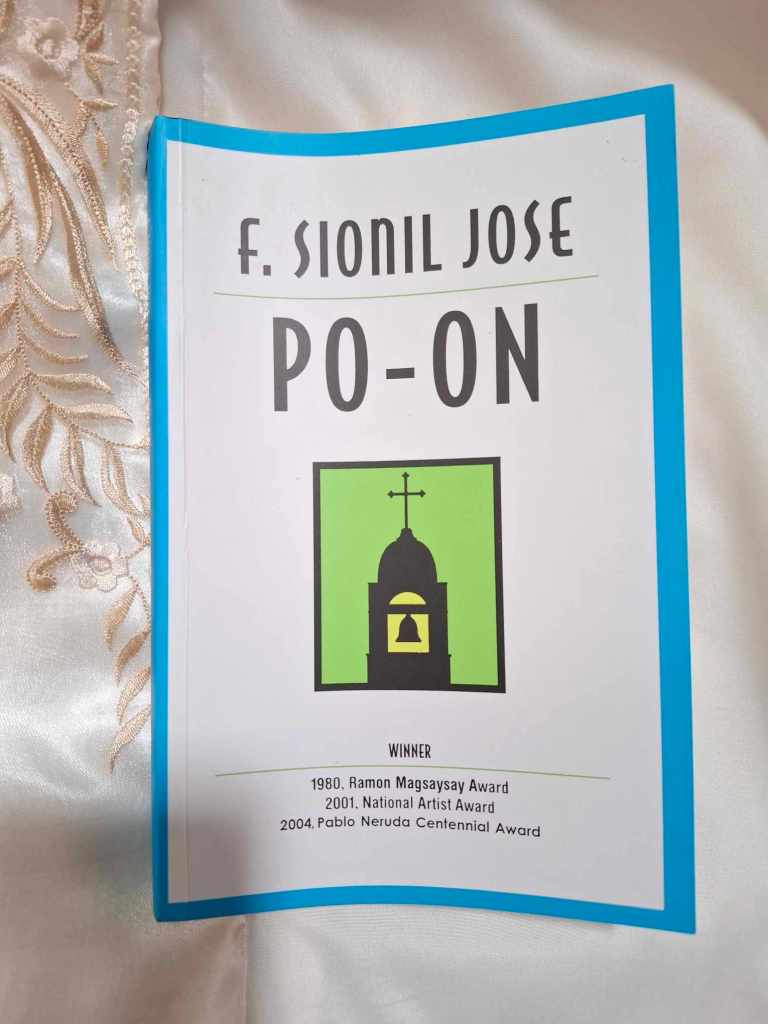
“There was no measure for love of country except in sacrifice.”
The beginning is all. The first scene in a play or a movie sets tone and mood, introduces characters and themes. For man, they say the infant is the father to the grownup.
And for this widely-acknowledged literary masterpiece, Po-on is the first yet last, chronologically the earliest yet the final book to be written in 1984 after four other novels (Tree, My Brother, the Executioner, The Pretenders, and Mass).
While this is not my first read by National Artist F. Sionil Jose, it is the first book I’ve read of his magnum opus, the Rosales saga (named after the author’s hometown: Rosales, Pangasinan).
What strikes this reader – apart from the sadness (for Philippine colonial history is never mirthful) – is the strength of character and the hope that accompanies it, which goes beyond words and is demonstrated by characters’ deeds.
So intimately do we come to know its main character, Istak/Eustaquio Salvador/Samson (the name change is perhaps a metaphor for that quest for identity, the peace that comes with self-knowledge that we all want yet few ever find). Born as a farmer, educated by a kindly Spanish priest in the twilight years of the Spanish reign, Istak is caught up in the madness of mayhem despite his best efforts to escape by hiding in the mountains.
This reader mentally recoils from describing Istak as a mere character, because the protagonist of the novel is too complex, too well drawn for a two-dimensional book. I can almost smell Istak’s sweat, can practically feel the calluses on hands graced with blessed labor, the hardest yet holiest of all: nation-building.
It’s almost biblical, how Jose writes of the destruction of Istak’s Ilocano village of Po-on, forcing their great exodus through the wilderness and forests uphill, battling brigands, headhunting tribes, and the feared invaders (first Spanish, then American).
It approaches the mythological, as Istak becomes Mabini’s secretary during the time the latter convalesced in Rosales and wrote so many political tracts in English, “the language of our enemy – so that it could then be spread to many corners of the earth.”
It is clear that Jose’s weapon of choice is his pen, when he writes: “What are your feelings toward the language of our master which we have learned? Does it give you a sense of pride? Of being equal to them? … Language was a window through which he could see.”
An unforgettable reading experience unfolds through Jose’s unique English narrative. So much care went into the opening paragraphs, the loving descriptions of a sunset over the Ilocos region, the rapt manner the writer detailed their simple food, each grain of rice so precious that none must be wasted as it is scooped up with work-blunted fingers. It’s a hard life, full of sacrifice, but with its beautiful moments given such sacred treatment by Jose’s pen.
The local belief that a building demands blood sacrifice is a fitting image for Jose’s conception of the creation of our nation. And with him, his pen’s ink might as well be his arterial blood. So passionately does he make his characters speak, not with the logic and reason of education, but the pathos of an ardent patriot.
It is an unusually high-pitched emotional book, and a memorable introduction to this saga!
~ ~ ~
The complete set cost P1,365.00 from Solidaridad Bookshop. Readers who wish to order may message them payment and arrange for pickup by courier.
ABOUT THE AUTHOR:
Gabi Francisco is a classically trained soprano who now performs in the English / Music / Drama classroom. On weekends she soaks in as much art and literature as she can, so she can pass her love for the arts on to her students. She passionately believes in the transformative role of arts education in nation-building. (IG: teacher.gabi.reads )
 Ex Libris Philippines
[…] Read our review of Book 1 (Po-on) of the Rosales saga here. […]
LikeLike