

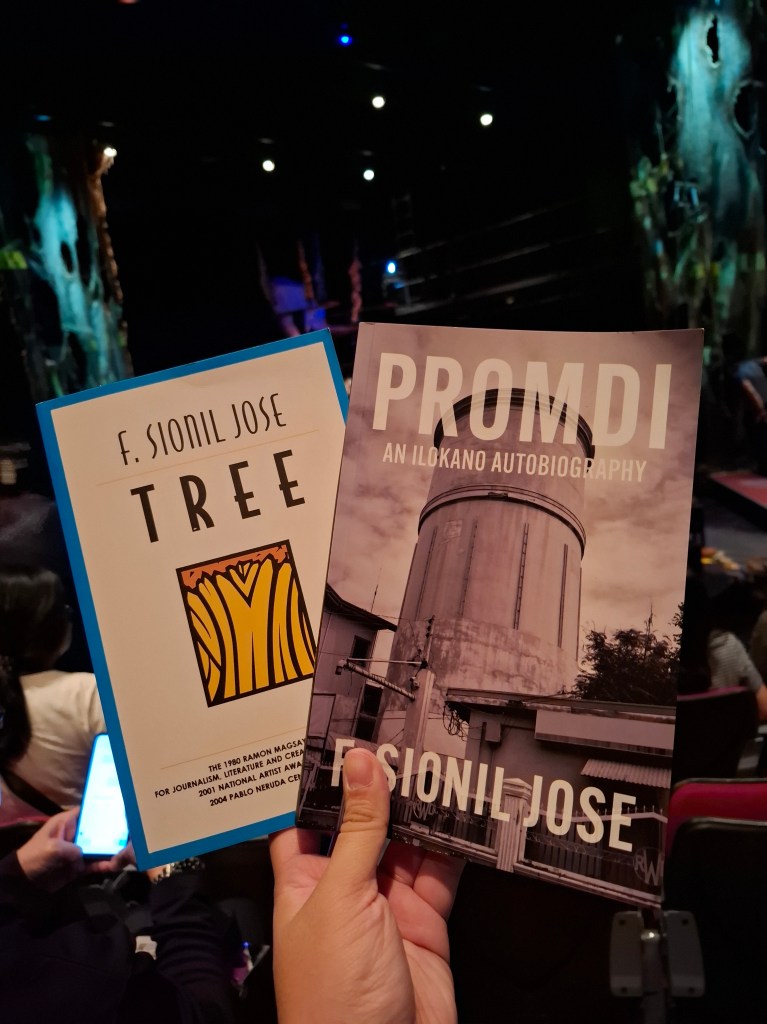
Every beginning of November, Filipinos reenact the ancient tradition of going home to one’s province, to the land that birthed us, to the cemeteries that still house the fleshly remains of our ancestors. This story begins, and ends, in such a graveyard.
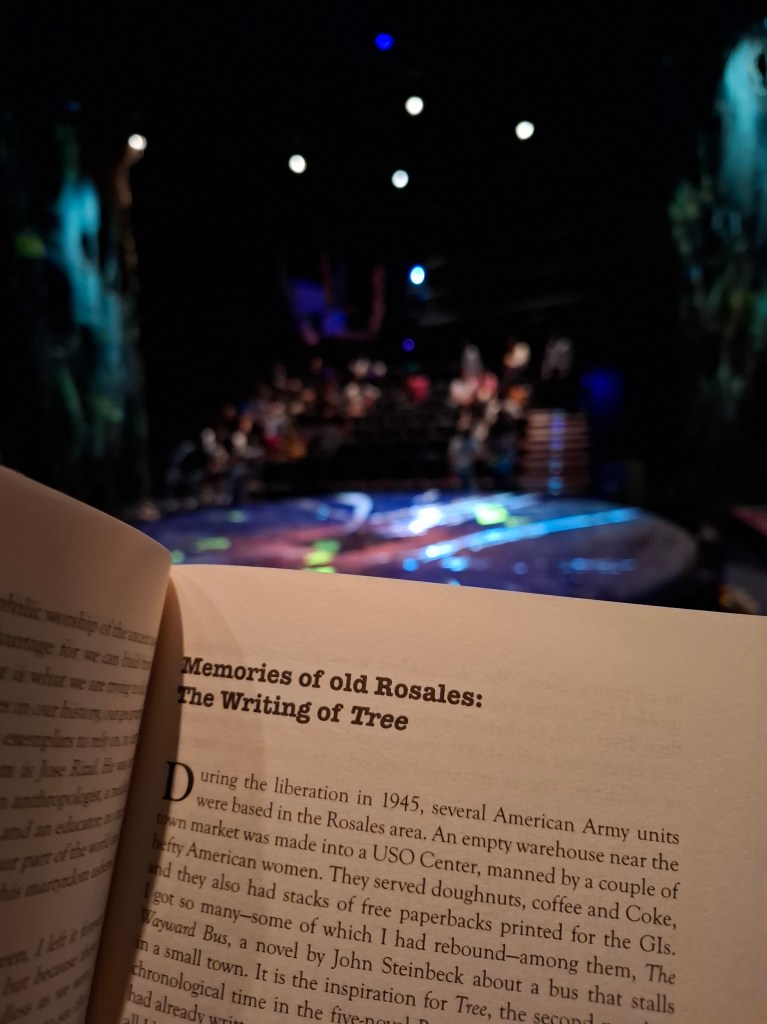
Books and plays inspired by them are always two different art forms, yet in this particular production, the performance enhanced the source text in a most remarkable manner. It truly was a case of the word becoming flesh, and becoming all the more powerful because of it.
TREE, written in 1978, still has power nearly half a century later. Told from the point of view of an unnamed character, the son of an abusive landlord’s similarly abusive overseer, both the book and the play introduces us to a people more than a story. We meet this only child’s playmates and housemates, one after another, each encounter described with an ever – increasing buildup in menace. The man who was the child looks back with the understanding of an adult, and sees how every interaction, no matter how innocent its beginning, was fated (doomed?) to an unhappy end. The termination of each friendship is heartbreaking, and the effect on the audience long-lasting.
To those who grew up thinking that uniformed maids eating different, simpler food from their employers are “normal,” to those accepting such an unjust state of affairs, F. Sionil Jose’s story is an indictment and a call to action. This division, this generations-old social injustice so firmly rooted in society like the titular indestructible balete tree, is the real enemy. Spaniards, Americans, and other colonizers come and go. Yet the exploitation done by the haves to the have-nots remain even today.
Rody Vera and Tanghalang Pilipino did a wonderful job with the devised script for this production. While they took some creative license in adding/changing a few parts from the book, they still kept very true to its core.
There was a metaphor involving the little girl who was part of a travelling circus, who lost her balance and fell to her death after coming into contact with the soil of Carmay, the land that our protagonist’s father takes care of for haciendero Don Vicente.
I had not realized that the precarious balancing act also symbolized life for all the Filipinos living under the yoke of serfdom, until this was emphasized by a few additional lines in the play, the meaning of which I had missed from merely reading the novel.
F. Sionil Jose wrote the play in English, and for the most part, the protagonist (played by Nonie Buencamino, who in a stroke of casting genius also portrayed his father) spoke in English as well. All except in the end, when he comes to terms with how he cannot escape the doom of his patrimony, the man/child speaks out in Filipino, crying out in anguish about how deep roots go, the secrets beneath as fathomless as wounds. His use of Filipino in a moment of crisis, then, signals his realization that he has unwittingly benefited from the abuse of his fellowmen, all of whom played a part in forming him. It is, in one sense, a killing of part of himself.
And this dramatic moment truly captured the play’s power, because the lines originally written in a colonizer’s language (which F. Sionil claims is for wider readership by an international audience) strike to a Pinoy audience’s very soul when transformed in our mother tongue.
The book is always there to be read, but the play is a fleeting thing. Watch it. Be disturbed by it. And try to change what little you can, in your own way. The tree of social inequality stands, but only because we let it.
~~~
[The reviewer purchased the entire set of the Rosales saga – all 5 books – from Solidaridad Bookshop for only P1,365.00. Tickets for Tanghalang Pilipino‘s BALETE cost P1,500.00 – P2,000.00 and are available from Ticketworld. The show runs until Oct. 6, 2024. Solidarid Bookshop had a table in the CCP Black Box Theater lobby on the day that I watched, where TREE and other books can be purchased.]
Read our review of Book 1 (Po-on) of the Rosales saga here.
ABOUT THE REVIEWER:
Gabi Francisco is a classically trained soprano who now performs in the English / Music / Drama classroom. On weekends she soaks in as much art and literature as she can, so she can pass her love for the arts on to her students. She passionately believes in the transformative role of arts education in nation-building. (IG: teacher.gabi.reads )
 Ex Libris Philippines