

Baguio is awash with tourists and Manileños all bundled up in Uniqlo Heattech this Christmas and New Year season. There may be another reason for the cold atmosphere: the chill of the supernatural. The Baguio depicted in OHA by Krie R. Lopez is one peopled by ghosts.
The book starts with a teenager’s death from illness. The year is 1949, and the beautiful city of fog and pine is recovering from a world war, with the last of the Japanese forces making their final stands in the mountainous region.
With a ghost for a protagonist, one might think that this is a horror novel. But when this reader finished the book, I came away thinking that it is more a book about a haunting (in more ways than one).
Spirits can haunt places, and a lot of characters are spirits in a peaceful area in the environs of Camp John Hay and Baguio Country Club. Those familiar with the places immediately sense that these are for the elite, and the author uses the venue to draw comparisons between the lives of the wealthy homeowners and the local people whom the rich depend on to cook and clean for them.
Ghosts can be haunted, too, by the unsaid and undone missions in life. In Lopez’s book, the spirits who remain instead of going to the light are stuck for this reason.
Mia, dead at fifteen, remains in the house her father built, waiting and learning truths about the world and herself even from the grave, for the next fifty years. We see the history of Baguio through her eyes. Lopez’s description of the aftermath of the catastrophic 1990 earthquake is unforgettable: a landscape littered with ghosts, many unaware that they have perished. Her description of the haunted Kennon road is also memorable, and this reviewer shall never look at the car/bus trip in the same way again, now knowing how thousands have perished in its making.

The book’s strongest points are its very strong beginnings, and the youth of its protagonist immediately captured the heart of this reader. Lopez also managed to describe an afterlife that fits in the narrative of Christianity (a priest suggests that this is his purgatory) while at the same time blending it with the yokai of Japanese folklore (shapeshifting spirits) as well as Filipino Pre-Hispanic beliefs.
However, the fact that this is the author’s debut novel is obvious, as the writing tells instead of shows, and sometimes the action is described in vague and often repetitive terms. Diwata and yokai “interact,” and the yokai keep “enveloping” the spirits they torment.
The author had so much to say, with so many opinions on varied topics, that the narrative flow would be interrupted by commentary so often, even though it seemed rather contrived at times.
One example is when Lopez puts these words in the mouth of a priest, “In my ignorance, I’ve convinced women to stay married to violent husbands… I’ve advised headmasters to be stern on the sins of the flesh and on homosexuality…” This is but one example of why we strongly recommend that teenagers or children reading this do so with a parent.
There was an unusually vague trigger warning on the back flap which read “Content Warning: Contains scenes that may be disturbing to some readers.” Those who are considering this book for children need to know that the “disturbing content” includes rape (thankfully handled sensitively by the author, without going into explicit detail), as well as the death of infants and very young children.
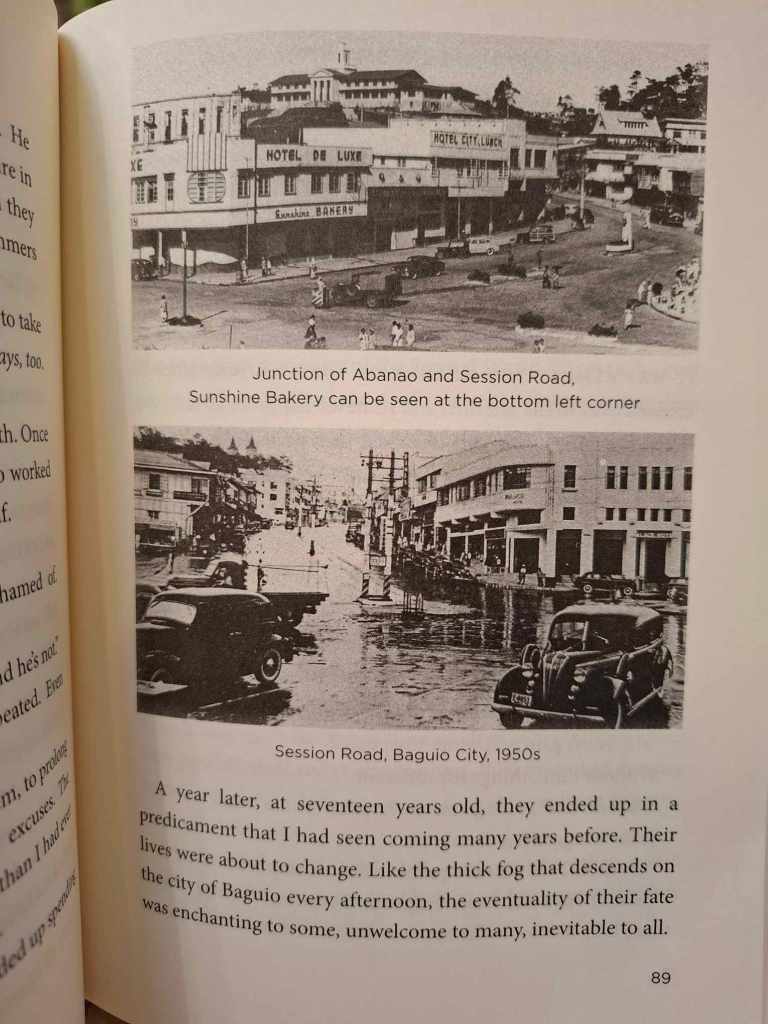
The photos in the book, while giving a lovely historical feel, sometimes have little or no connection to the text. There is one photo that might trigger readers as well, a photo of a corpse in the sangadil position (an Ifugao tradition where the deceased’s body is arranged seated on a chair, and displayed to visitors).
Discussion and processing are recommended, should this book be gifted to YA readers.
[The reviewer received a copy of OHA. It is readily available for P399.20 (on sale) from Milflores Publishing]
ABOUT THE REVIEWER:
Gabi Francisco is a classically trained soprano who now performs in the English / Music / Drama classroom. On weekends she soaks in as much art and literature as she can, so she can pass her love for the arts on to her students. She passionately believes in the transformative role of arts education in nation-building. (IG: teacher.gabi.reads )
 Ex Libris Philippines