
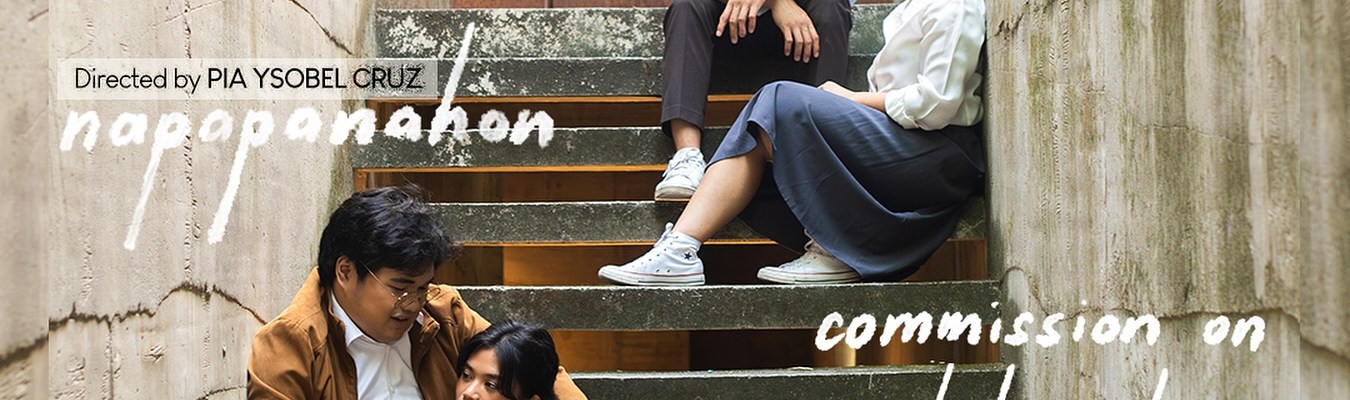
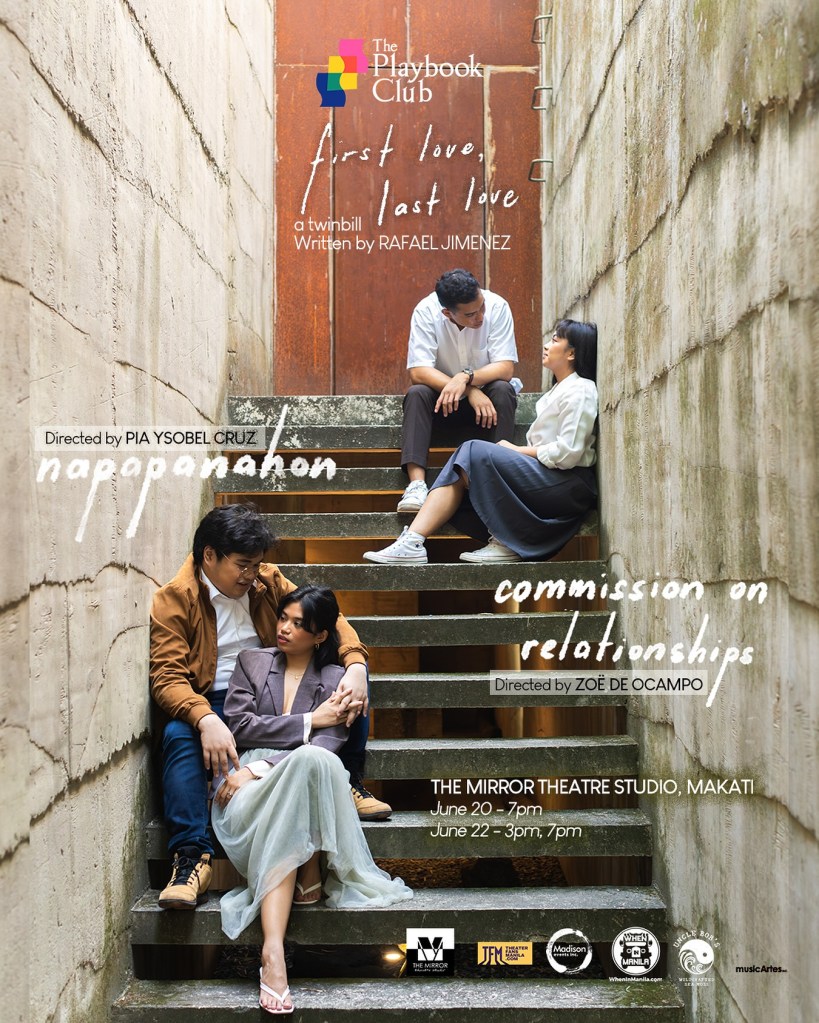
(Photo credit: The Playbook Club)
To watch a show both written and produced by young theater artists mostly in their twenties is a refreshing theatergoing experience. There’s that fearless idealism, which is the hallmark of college plays, merged with the growing awareness of the callous, grown-up world beyond the walls of sheltered universities. But then the seamless coordination of lights, sounds, and the smooth assuredness of most of the young cast drive home the point that these are undoubtedly professionals who yet see the world through the eyes of an artist: discontent with the way the world works, yet quixotic enough not to accept it.
The Playbook Club (PBC) has come a long way from its beginnings in the pandemic, with its creatives using Zoom to make art despite all the barriers of illness and distance. With such a difficult genesis, they now strive to make new art truthfully and joyfully.
First Love, Last Love is a twin bill featuring two plays written by Rafael Jimenez, both original meditations on how to live and love in the Philippines. What was particularly noteworthy is how different the two plays are from what I initially thought would be feel-good romances, based on the posters. There’s a great deal of kilig and love between the two couples, yes, but in no way do the two plays fit under the neat category of romance, with the Disney happy-ever-after (HEA). Instead, Jimenez has written social commentary in disguise. Hidden behind the sweet-yet-awkward meet-cutes and classroom song-writing sessions are serious questions about the limits of government control over private citizens, the abuses of bureaucrats and authorities, and how much a person changes through time.

(Photo credit: The Playbook Club)
In the first play, Napapanahon, the lights opened on a high school classroom (the date written in chalk: March 12, 2020). We see the assigned cleaners’ names: Ruby (played by Erika Rafael) and Arthur (essayed by the extremely soft-spoken Los Akiyama). Upon Ruby’s entry, I was struck by how much older she seemed, dressed as a mature career woman in heels. And the way she gazed at her boyfriend, Arthur, half in disbelief, half in reverence, spoke volumes.
She tries to tell Arthur that she is from twelve years in the future. Naturally, the easy-going youth thinks she’s kidding, until Ruby produces the exact same notebook full of songs that Arthur also has, which leads to a series of questions about the kind of tomorrow Arthur can expect. Then a truth bomb is quietly dropped, a twist which some in the audience might have seen coming, but Director Pia Ysobel Cruz and her actors handled Jimenez’s text with great sensitivity, without falling into the temptation of sensationalism. Sans the melodramatics, it lent extra meaning to the simple closing lines, and somehow made the conclusion all the more touching.
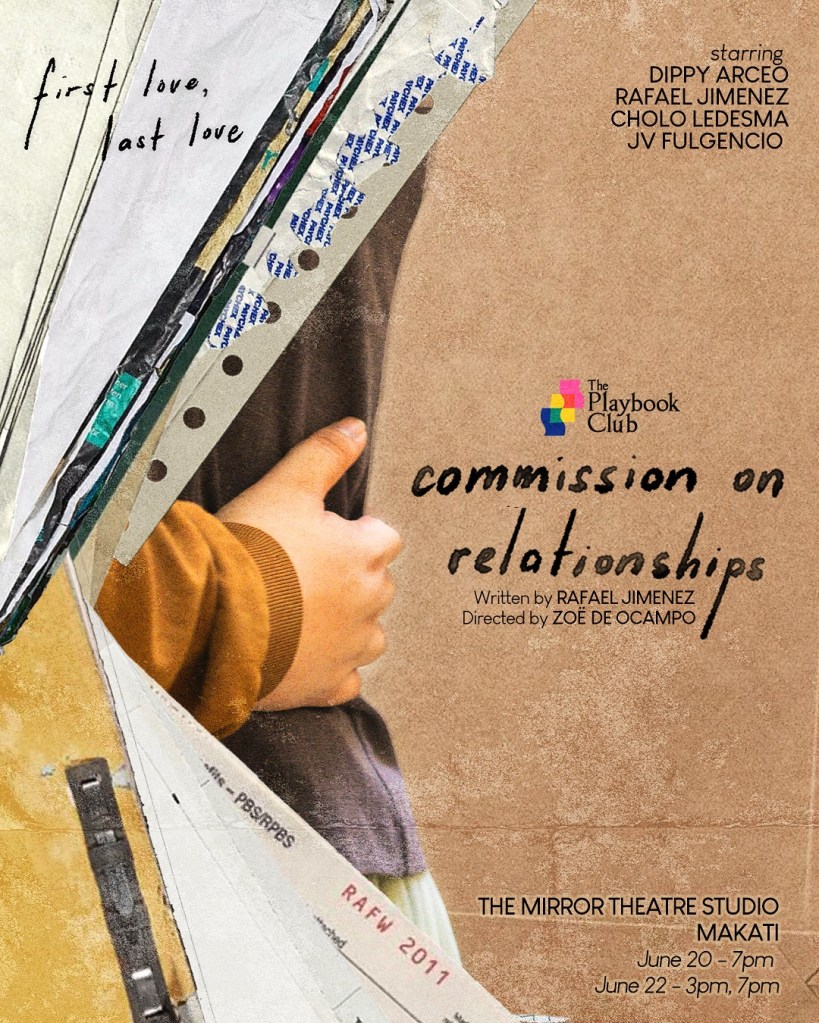
(Photo credit: The Playbook Club)
The second play, CoR (Commission on Relationships), was directed by Zoë de Ocampo and featured the playwright, Rafael Jimenez, as the writer Lau, paired with Dippy Arceo as his love interest, Luna. Cholo Ledesma and JV Fulgencio shone brilliantly in scene-stealing supporting roles as priest and senator, and both as government office clerks.
I imagine that Manila audiences freshly reeling from the new financial burden of the digital services tax can sympathize greatly with the play’s premise: a not-too-distant future when relationships are strictly monitored by the government “to protect love and counter over population, because less children means less carbon footprints.” If couples wanted to hold hands or sleep in the same hotel room before marriage, they first have to pay P600,000.00 and register their relationship.
What first seems to be an us-against-the-world tale becomes an exploration into the consequences of government overreach into what should be a private and sacred relationship. For how can the fragile flower of love bloom, with the added pressure and heat of taxes and labels?
While the play’s second half veered into surrealist territory for this reviewer, there’s no denying the broad appeal of Jimenez’s writing. It came as a pleasant surprise to this audience member to find that his humor is easy and light (because I’d previously seen him act in heavy Shakespearean tragedies), his characters fully fleshed out and utterly sympathetic despite their flaws. His most confused and contrary character, Luna, was brought completely to life by the talented Dippy Arceo, fresh from acting as Elec(k)tra in a modernized version of the ancient Greek classic. And if the ending of CoR was not satisfying, perhaps that is the point. With a government full of paper-pushing clerks who seek citizen compliance above public service, Jimenez shows that the dehumanizing bureaucracy is enough to drive even the sanest person mad. Perhaps dissatisfaction is what it’s all about.
In a world full of woke cynicism, shows like First Love, Last Love are a welcome breath of fresh air for their sincerity and innocence. To loudly proclaim their hope for better, for more, is a form of rebellion. For PBC, writing and performing plays becomes a way of making meaning out of our modern mayhem, and audiences leave not only entertained, but also wiser for having seen them.
~ ~ ~
[The reviewer was invited to the preview of The Playbook Club‘s First Love, Last Love. Tickets are available for P850.00. They run for one weekend on June 20 and June 22, 2025, at The Mirror Studios, Poblacion, Makati.]
ABOUT THE REVIEWER:
Gabi Francisco is a classically trained soprano who now performs in the English / Music / Drama classroom. On weekends she soaks in as much art and literature as she can, so she can pass her love for the arts on to her students. She passionately believes in the transformative role of arts education in nation-building. (IG: teacher.gabi.reads )
 Ex Libris Philippines