
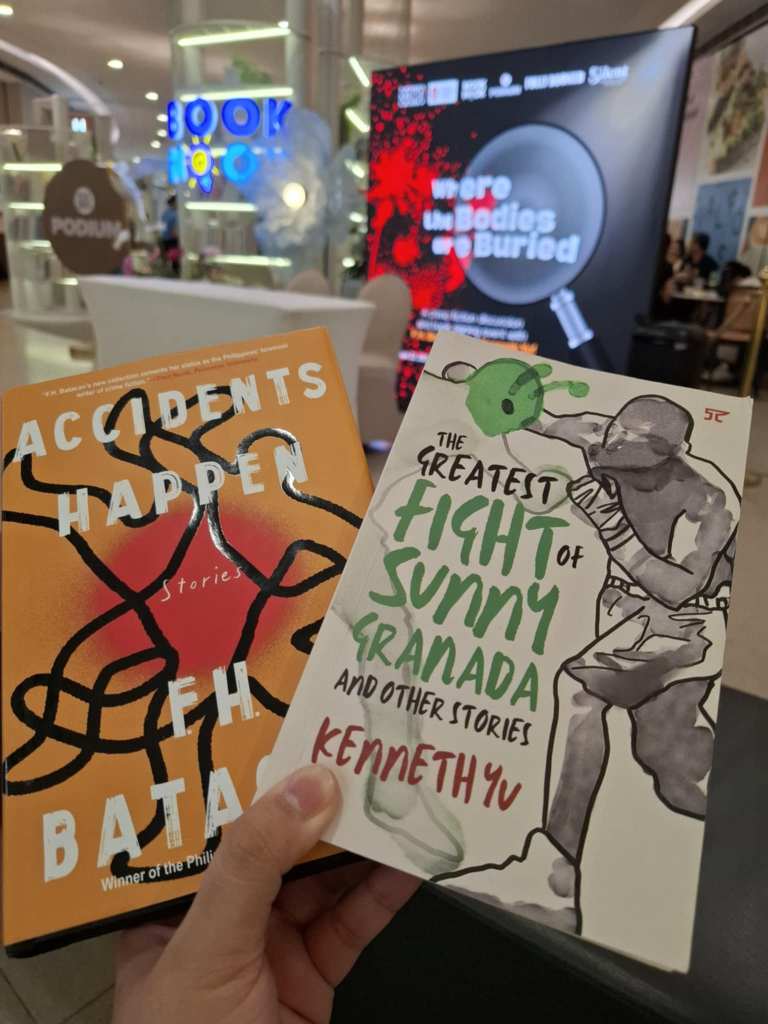
What author doesn’t dream of writing a book that inspires a movie, now available to stream on Netflix? F.H. Batacan’s SMALLER AND SMALLER CIRCLES (written 26 years ago) not only pioneered a genre (crime fiction) and won the Palanca and the National Book Award, but also got picked up by Soho Press for international publication. Sid Lucero and Nonie Buencamino starred in the TBA Studios film version that came out in 2017. And yes, it’s now available to view on YouTube and Netflix.
Nearly a quarter of a century after her first book, F.H. Batacan has now written her second: a collection of short stories entitled ACCIDENTS HAPPEN, featuring some of the characters in her first book.
Batacan recently embarked on a series of book signing events and talks. This reader was fortunate enough to be in the audience on June 22, 2025 for “Where the Bodies are Buried,” hosted by author Kenneth Yu and organized by Fully Booked, Penguin Random House, SM Podium’s Book Nook, and Silent Book Club Manila.
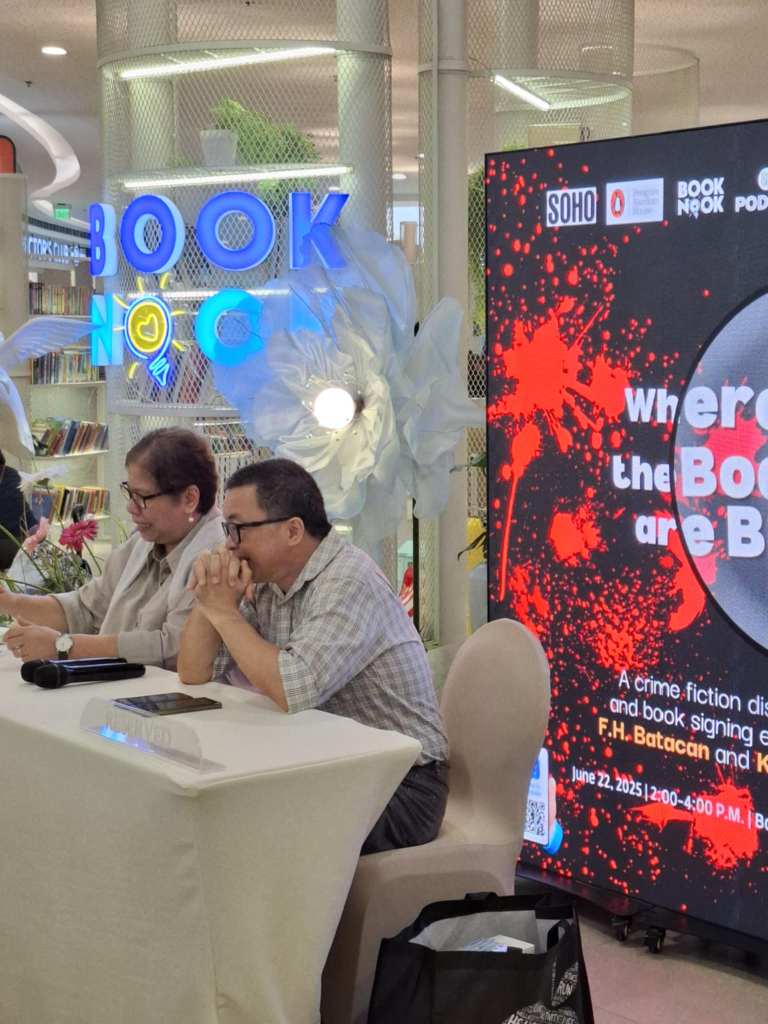
Kenneth Yu started by saying that they would pretend to be having a candid conversation over imaginary coffee. Batacan interjected with “Where’s the pastry?”
What ensued was an overview into the creative process of the doyenne of Filipino crime fiction.
Yu mentioned that the top genres in local literature are romance, horror, and the supernatural, and that crime has yet to find its place, but is on the rise. He asked why that was.
Batacan mentioned the importance of representation, of having more Filipino writers write crime fiction, for more Pinoys to read, and for a greater community to be built. When asked if she thought there was room for a Filipino genius like Sherlock or Poirot, she remarked on the necessity of executing this well and believably. She also said that her protagonists (both Jesuit priests, one a forensic anthropologist and the other a psychologist) were deliberately made out not to be supermen. “They are ordinary men ready to serve, and that’s what makes them extraordinary.”
She also talked about the importance of compassion in her protagonists, with a clear understanding of place (encompassing the mental, cultural, political milieu that has people looking at policemen warily, and government officials skeptically). As her readers know, the Philippine setting is very much a character in Batacan’s work.
Yu and Batacan next talked about the evolution of crime fiction, from the old style that focused on logic and how clues add up to discover whodunit, to the contemporary penchant for “a clearer look into the humanity of the hero and the villain.”
Batacan went on to say that, unlike in crime fiction from the past, her works don’t end neatly. “Or if you do attain justice, it’s limited. At most, all you can arrive at is an understanding.”
Yu delved deeper, asking if this was indeed so, where does she draw the line between justice and vengeance taken to balance the injustice of the crime?
Batacan responded in terms of layers. Taking an example from her newest book, she said the primary layer could be the discovery of a dead body. The next layer would be the frame up, and the third would be the cover up (especially if the guilty party were an important and respected member of society).
“The real crime is the crime behind the crime, what I call The Machine. It is the structure, the systemic frameworks, beliefs, legal and administrative guidelines that give rise to the primary crimes.”
Yu added that this is the function of crime fiction. “It reveals imperfections in the machine, exposing the whys, the very ground in which it is built.”
Batacan wrapped up their discussion with her thoughts about crime fiction in the Philippines. She believes that what matters is the connection made between writers and readers, both receptive and new ones, in order for The Shift to happen.
For Batacan, The Shift can happen to the main character, or to the reader. “It is when the curtain is peeled back, and you can see the machine and become aware of it for the first time… these everyday violences that allow no real freedom of movement. The more people we reach, the more people will become angry. And the way we can change our society is through anger. Passivity is a capitulation. What really works is when we make our voices heard.”
The discussion was followed by a short reading from the book (specifically pages 123-125), featuring Batacan’s description of the wife of a mayor. Instead of looking at the surface, she discussed how the other characters viewed the socialite.
There was time for a few questions from the audience, where we got to learn more about her writing process, her aim to end stories with ambiguity (“What is the real monster? It’s not the ghosts who exact vengeance, but why they have to exact vengeance in the first place.”), and again, her goal as a writer.
“I’m not after closure. I want agitation. Closure implies “tapos na.” My purpose is to get my anger out and share it. Anger can push you to the next step. Whether it is a small one like handling evidence, or big like the way we vote… it’s progress. The enemy of change is complacency and being comfortable.”
The session ended with three story pitches from members of Silent Book Club Manila, and the book signing portion.
This reader emerged from the book event hoping to learn, eventually, how to channel rage with the grace and peace that emanates from F.H. Batacan, she with the warm smile and a pen and mousepad for all who came.
I glance now, gratefully, below my Logitech mouse, at my orange daily reminder to continue to rage against the machine, but productively and with grace. It’s not called “The Good Fight” for nothing.
(Quotes were edited slightly for brevity and clarity.)
[Click here to read the Ex Libris Philippines review of ACCIDENTS HAPPEN.]
 Ex Libris Philippines