

“For the world of tales is the land of legend and dream, even if the characters move and speak in the here and now. And sometimes, it seems to me that only sorcery and enchantment can capture the strangeness of ‘real life.’” ~ Cristina Pantoja Hidalgo
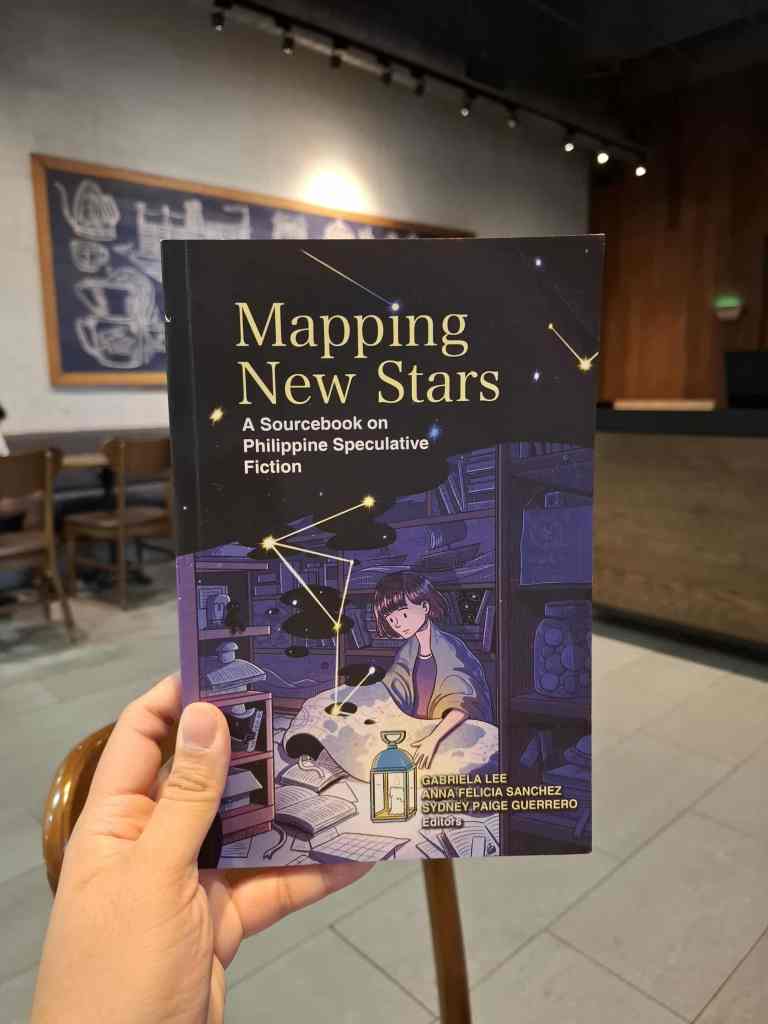
It took reading this World Fantasy Award winning book for me to realize how deeply Filipino literature is immersed in speculative fiction, aka “spec fic.” From Ibong Adarna to the stories of Lola Basyang, one might say that we have always been a nation of spec fic readers and writers.
“Mapping New Stars” describes itself as a sourcebook for students and teachers interested in that most inclusive of genres called “speculative fiction.” To be honest, I was expecting that it would be full of short stories or excerpts from the incredibly rich treasure trove of local literary giants. However, the book proved quite different.
It is a collection of seventeen articles (twenty if you count the two in the introduction and the afterword as the last one; most are written in English while two are in Filipino). Divided into two sections marked “Reading” and “Writing,” the book offers both an academic theoretical overview of Filipino fantastic literary history, as well as practical advice for would-be writers on both the crafting of the tale and the commercial aspect of publication. I can’t think of another book that marries both the ivory tower and the marketplace in one collection, which perhaps explains why the volume won the prestigious World Fantasy Award (Special Prize) this month.
The lay reader will find herself jotting down books in her Christmas wish list after every page, as the articles detail the incredible depth of Filipino creativity in a genre that, for a long time, wasn’t considered serious nor legitimate.
This book should be read by any hoity-toity don too enamored with the poetics of James Joyce and Proust. As “Mapping New Stars” very clearly shows, spec fic is both compelling and serious, with vast potential for subversive thought in a genre that criticizes the present, yet offers solutions for the future.
If there is one slightly dissonant tone in a book full of song, it is that one article seemed overly harsh in its criticism of other spec fic authors’ works. If one were not the author, how can one presume to know their creator’s intention? Calling some stories “missed opportunities,” just because they didn’t provide an ending that suits the interest of the article researcher, seems a bit presumptuous.
“The Speculative Impulse” by Michaela Atienza and the afterword by Cristina Pantoja Hidalgo are two of the most memorable articles in the book, as they discuss the essence of spec fic and summarize the articles within.
Victor Fernando R. Ocampo’s “The Roots of Speculative Fiction in the Philippines” was also impactful, tracing spec fic’s roots to epics in the precolonial oral tradition, like Biag ni Lam-Ang. And now I’m on the search for a copy of Doktor Kuba, written in 1933 by Fausto J. Galauran, who was a doctor at PGH and Chinese General. It’s said to be the earliest written sci fi tale in our country.
The second half of the book (“Writing”) has gems like Charles Tan’s “Philippine Speculative Fiction on the International Stage,” with hard facts about the reason Pinoy authors choose to write in English for worldwide readership, including what an author might earn from local versus international publication.
We also have acclaimed spec fic authors like Eliza Victoria giving tips on how to write a novel or a short story, Dean Francis Alfar on world-building, Nikki Alfar on creating characters, Isabel Yap on planning the narrative, and Yvette Tan on how to write horror stories.
The book is a literal treasure trove, perhaps not the kind I was expecting, but still incredibly valuable all the same for the breadth of its coverage and the wealth of what was, before, almost privileged information.
~~~
MAPPING NEW STARS: A SOURCEBOOK ON PHILIPPINE SPECULATIVE FICTION is available for purchase from the University of the Philippines (UP) Press for P620. It is also available in Shopee.
~ ~ ~
ABOUT THE REVIEWER:
Gabi Francisco is a classically trained soprano who now performs in the English / Music / Drama classroom. On weekends she soaks in as much art and literature as she can, so she can pass her love for the arts on to her students. She passionately believes in the transformative role of arts education in nation-building. (IG: teacher.gabi.reads )
 Ex Libris Philippines