
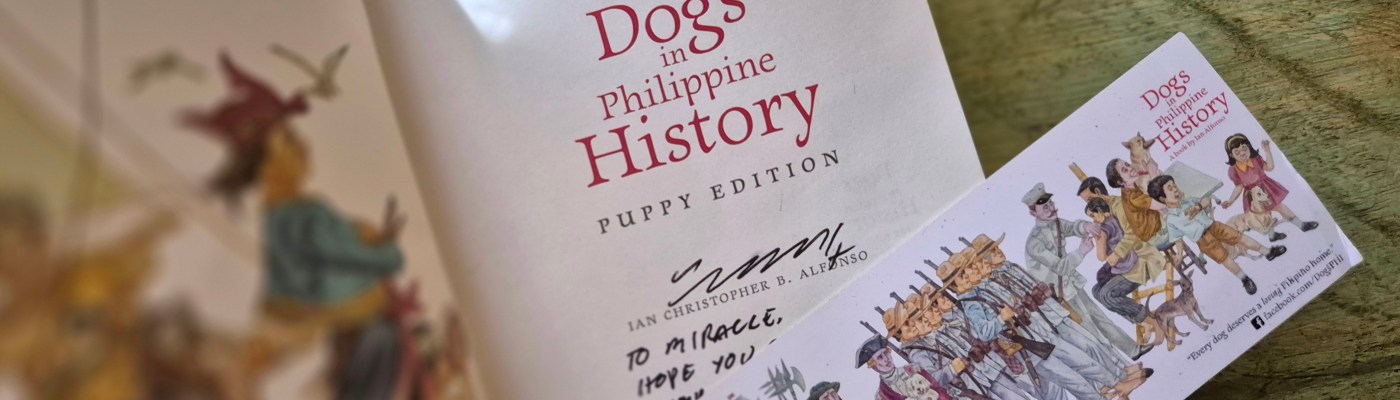
One emerges from ‘Dogs in Philippine History’ with a heightened affection for the aspin and a better understanding of our nation’s past.
The aspin is a neologism formed from Asong Pinoy (Filipino dog) that has supplanted the older term “askal,” a blend word that stood for Asong Kalye (street dog). The older portmanteau is loaded with a deep historicity, tracing back to the Spanish colonial period. But it consigns the native dog to the streets, whereas the newer term raises an interesting question: does the aspin reflect who we are as a people?
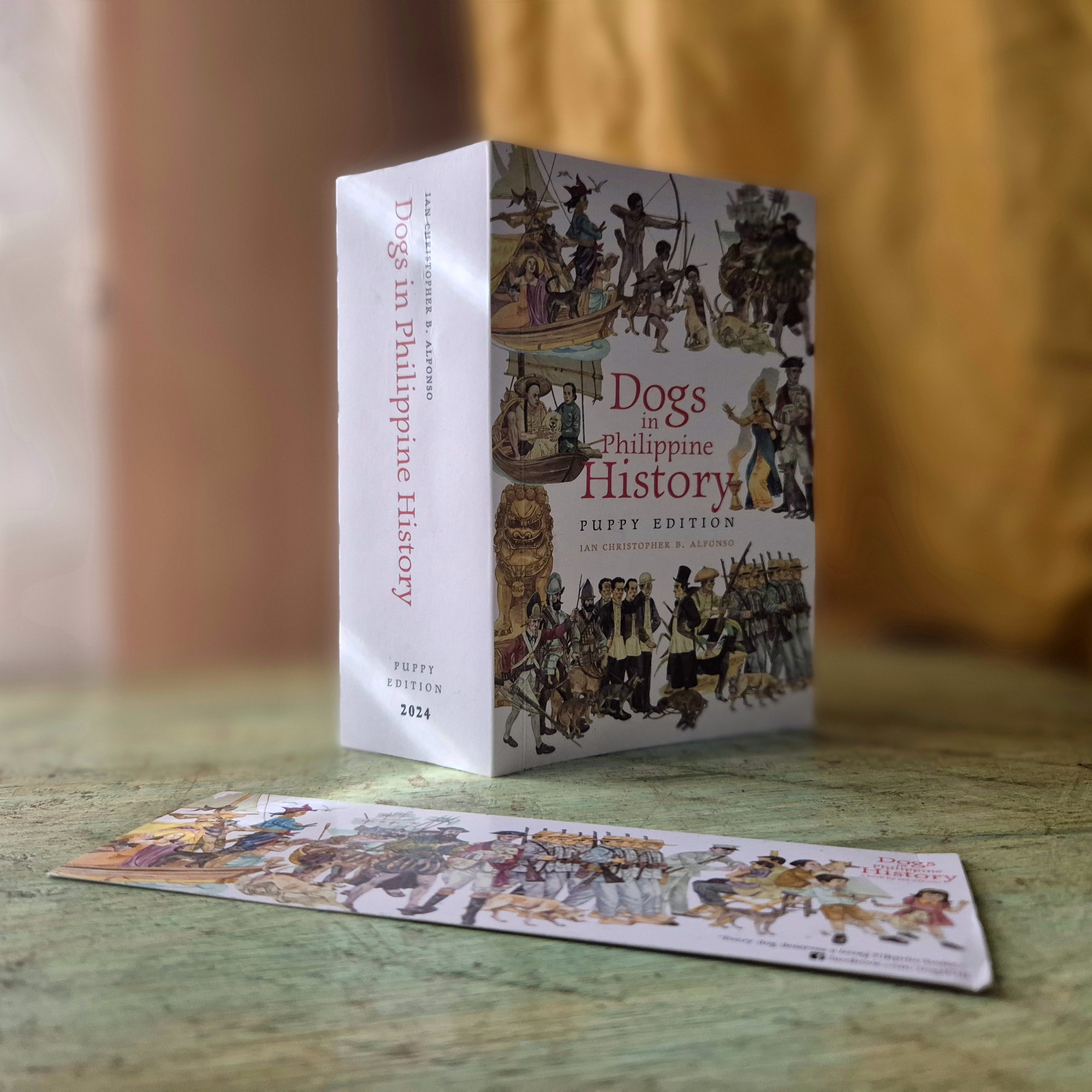
Ian Christopher B. Alfonso’s book was published in 2023, but it aptly appeared on this reader’s radar in 2024. It was amidst the fiasco of a well-known restaurant in Luzon that welcomed patrons with foreign dog breeds, but denied entry to an aspin. Gideon Lasco wrote an article that referenced Alfonso’s book in response to the debacle, and in defense of the marginalized dog breed. Around the same time, an improved version of the original book (cutely called the “puppy edition”) was released. Attendees of the Manila International Book Fair 2024 were smitten by the book’s unique dimensions and beautiful cover illustrated by Roderick Macutay. Within the same week, ‘Dogs in Philippine History’ was announced as one of the nominees under the history category in the 42nd National Book Awards.
Alfonso, an assistant professor of History at UP, is a prolific historian who accidentally lost the original manuscript of the book in 2018, after reformatting his laptop. Disheartened, he left the project in limbo until 2021, when a homeless cat and dog kept frequenting his table at his favorite carinderia near the National Historical Commission of the Philippines. The pair inspired him to resuscitate the project and begin anew.
It is a collection of well-researched essays that encompass Philippine history, from the earliest archaeological evidence of dog domestication by our ancestors nearly 4,000 years ago, to stories of modern-day canine heroes who gained international fame (like Zamboanga’s Kabang). From the first chapter tracking the origins of our aso (dog) and its Austronesian roots, and all throughout the subsequent twenty-seven chapters, the book constantly reminds the reader of the inextricable role of dogs in Filipino culture and history, while simultaneously endeavoring (as the author writes in the prologue) to help us understand ourselves better.
The second chapter is especially astonishing for those who are interested in etymology, as it features the vocabularios, or vocabulary books written for the Spanish in the 17th century as an aid to more effective evangelization. These vocabularios, however, amazingly reveal how our ancestors had idioms and distinct terminology pertaining to dogs, including a list of specific words that describe how violence was inflicted on a dog, another list of words that express affection, and a surfeit of words on dog diseases that testify to how our forebears were cognizant of canine health.
Succeeding chapters recall a dog’s significance in many Philippine epic stories, along with the Kapampangan and Kinaray-a creation myths that narrate how the first woman was created from a dog’s tail, a purported miracle of a slaughtered dog in Bicol that was restored to life by Our Lady of Peñafrancia, the heralding of new dog breeds that arrived with the galleon trade, and how Manila was not merely an important trade route for exotic goods, but also for dogs. We hear of the advent of rabies and the mass killings of dogs during the British occupation, and the American propaganda that sought to justify their annexation of the Philippines by portraying Filipinos as dog-eaters, therefore savage, ergo incapable of self-governance.
But this book goes beyond mere chronicling and dedicates an entire chapter to Philippine dog memorials and the heart-warming stories behind them. Interspersed between the essays are also an extraordinary curation of artworks by Filipino artists and rare historical photos that feature our best friends.
This book is many things at once, but ‘Dogs in Philippine History’ is, above all, a work of love — for the aspin, for history, and for the country.
[Text and images by Miracle Romano. The reviewer purchased the book for P850.00. It is available at Shopee.]
~ ABOUT THE REVIEWER ~

Miracle Romano is a book-butterfly who flies off to places influenced by her literary choices and reads books influenced by her travels. She is a pianist, a music teacher, and a former columnist for the Mindanao Observer who juggles her time between two passions — words and music. More of her writing can be found here.
 Ex Libris Philippines
[…] Read the review at Ex Libris Philippines […]
LikeLike