
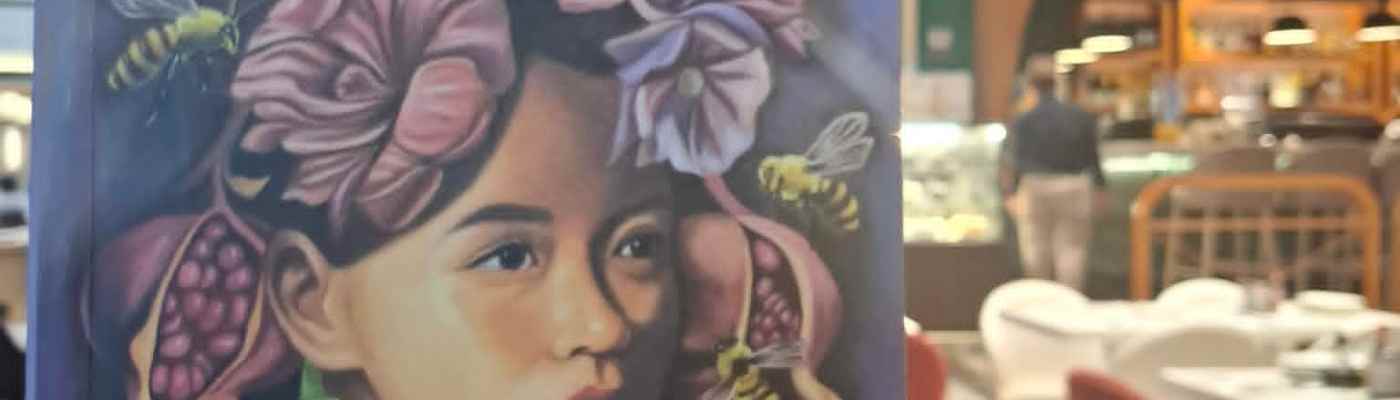

When we remember that honey bees die upon stinging, the title of Chuckberry Pascual’s short story collection starts to make sense.
“The Gathering Bees” was originally published in 2015 as “Kumpisal : Mga Kuwento,” then re-released as “Mga Bubuyog na Nagkumpulan,” translated into English by Ralph Semino Galán in 2025.
It is darker than the past book we read by him, and left this reader feeling melancholy upon finishing it. These are nine “recurrences” that record, in great detail, all the flavors, the gyrations, the horrors and pains of love between men.
“The focus of attention are the irregularities and fissures in the dominant ideology of love,” writes Pascual in his book’s introduction, adding that the book’s focus is on “love in the form of a quest, not for self-aggrandizement, but for self-understanding.”
Love that defies heteronormative social conventions is fraught with unique perils, as these stories show. We not only find petty thieves and call center agents, but also an aswang, a sigbin, and a kyawtibel (“an aswang that sniffs people”). Even a kapre makes an appearance by lifting a young man up into his protective embrace, surrounded by a sheltering balete.
What struck this reader the most in this collection of tragic love tales is a wonderful sense of place and time, with Pascual exulting in the smells and sights from the palengke (wet market), the over-crowded LRT trains, and depressed areas where we find our protagonists. They come from all walks of Filipino life, and yet Pascual has chosen to name them Gabriel and Alejandro nine times over, all throughout the changing occupations, ages, and stories. For isn’t the dance of desire eternal, with only the dancers ever changing?
“Love was love – no different from saying that a white undershirt was white because it had no color: there was no need to pass judgment on such a statement.”
Nine times over, Pascual brought reflections on the all-consuming, self-annihilating nature of desire, graphically told through flesh-eating creatures, armpit-smelling lovers, and men who camouflage their true selves by taking a wife, yet stealing away for stolen moments of illicit pleasure.
While all nine stories are memorable, a standout in the collection is “Sigbin,” about a woman who is lured by the aswang’s slave to be its meal, yet saves herself through sheer audacity. The monsters actually aren’t the source of my horror; some of the stories feature human protagonists so cruel, one actually murders an innocent babe, and the other hides a corpse under a mattress reserved for acts of love. That such bestiality is capable of a lover’s caress underpins the Dionysian thread that binds these tales of woe, with Pascual and Galán’s prose the only curbing element amid such wild abandon.
“They’re the new zombies… they aren’t able to establish a meaningful relationship. They’re alienated from their authentic selves… they’re comparable to the living dead.”
If meaning is found through pain and yearning, then the characters in the stories have it, in abundance. And if, upon the book’s end, we are left feeling bereft, then perhaps it has done its job: to illustrate the intimacy between destruction and desire so vividly, readers are left with fearful longing for the buzzing of hearts wildly alive, however briefly.
~~~
The reader received a copy of THE GATHERING BEES for review. It is available for purchase through Shopee (P520.00), courtesy of UST Publishing House.
~ ~ ~
ABOUT THE REVIEWER:

Gabi Francisco is a classically trained soprano who now performs in the English / Music / Drama classroom. On weekends she soaks in as much art and literature as she can, so she can pass her love for the arts on to her students. She passionately believes in the transformative role of arts education in nation-building. (IG: teacher.gabi.reads )

