
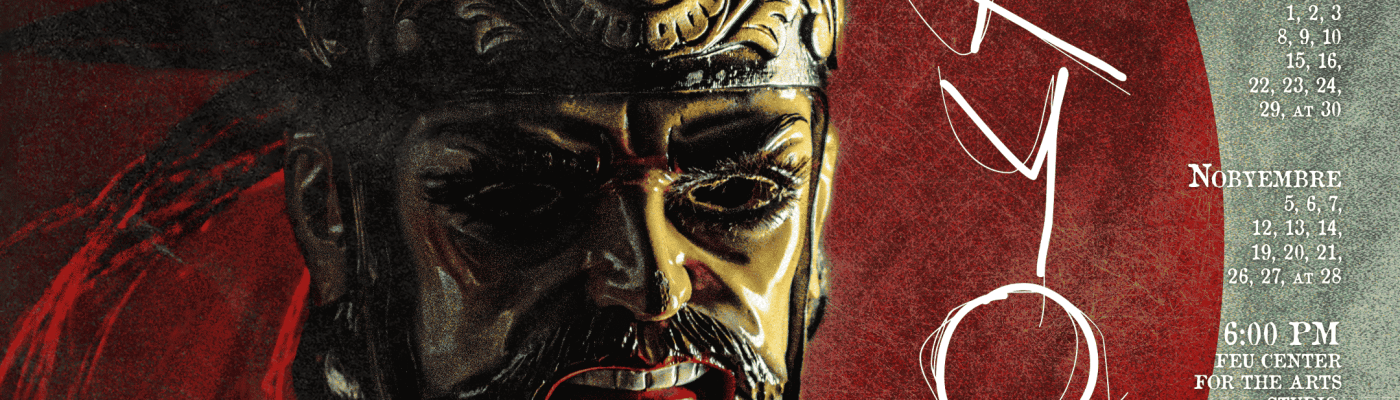
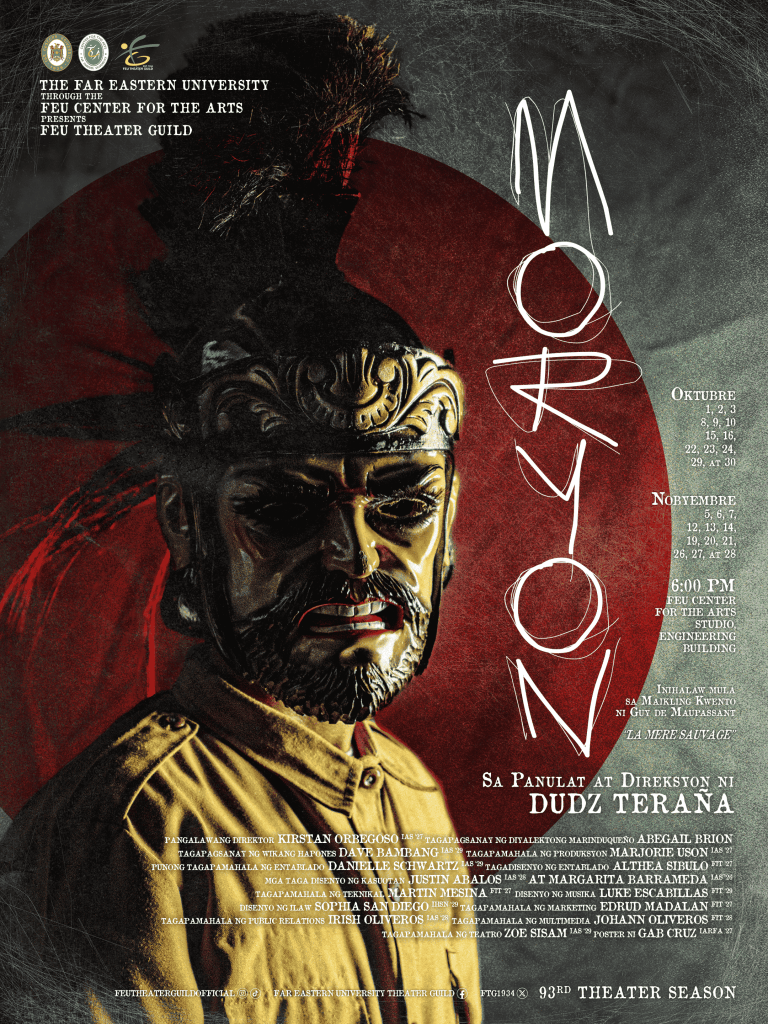
(Image courtesy of FTG)
FEU Theater Guild (FTG)’s 93rd season began with a highly polished rendition of Guy de Maupassant’s short story La Mère Sauvage, transforming the tale into a truly Filipino meditation on the intimate horrors of occupation that haunt our society still.
The mask of civility
Writer-director Dudz Teraña has transplanted this violent, woeful tale into Japanese-occupied Marinduque during WWII, using a unique (and, I daresay, historical) mix of Filipino, Marinduqueño (a dialect described as a deep yet distinct form of Tagalog), and Japanese (with a tiny bit of English thrown in).
As audiences are ushered into our seats, we behold Caridad (skilfully portrayed by Maria Ysabel delos Reyes) grating coconut meat in the middle of the set, which was a wonder unto itself. I shudder to think how many sackfuls of earth it took to transform the intimate theatre into the soil of a provincial home, complete with a kitchen (where Caridad later cooked several dishes, live!) and a well filled with water.
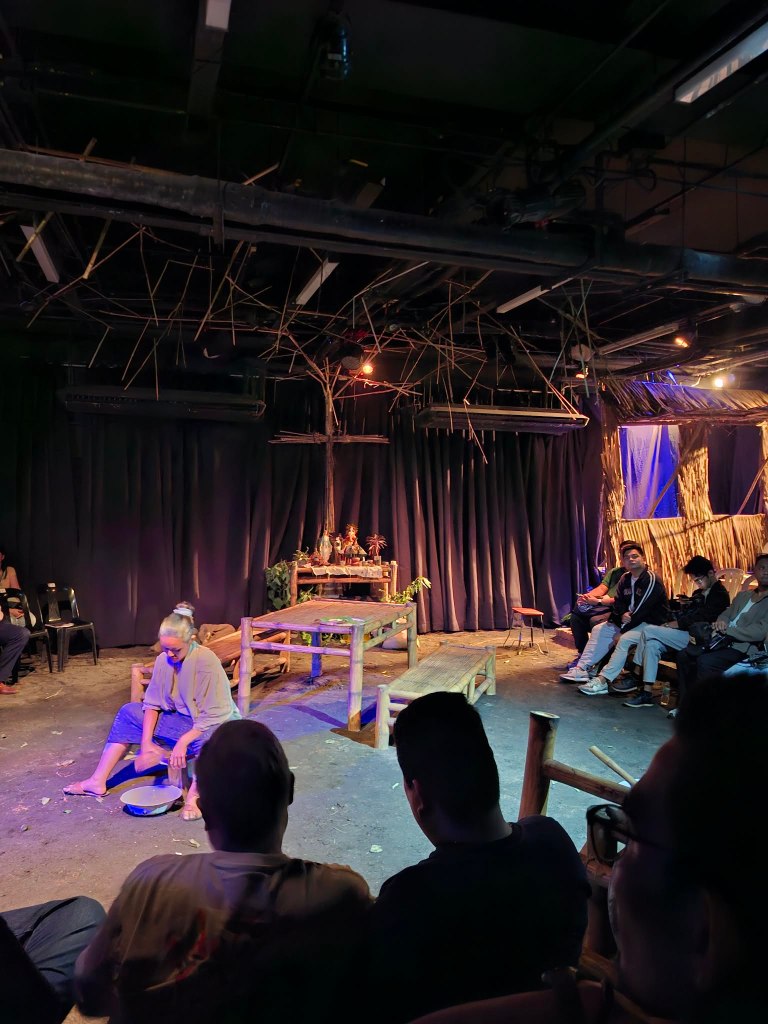
Neighbors descend, and what ensues is a musical murmuration of what sounds (to this Manila-born viewer) like an ancient form of Tagalog. Here is the Marinduqueño dialect in all its glory, delightful to listen to as the scene and stakes are clearly delineated.
It is Holy Week, and the Japanese occupying forces have come to the town of Mogpog in search of dissidents. Despite the situation, one has an overall impression of neighborly levity: we’re all in this together, so we will be alright.
In flashbacks we are given to understand that Caridad is all alone in her house, her strength made apparent as her tragic backstory is revealed. Plans for dinner are made, the neighbors depart, but then a Makapili neighbor and four Japanese soldiers walk in, demanding shelter and food.
Thus the table is set.
At first the enemy soldiers are polite, all bows and smiles, but then it takes only one word (“gerilya”) for the mask of civility to slip, and they are pointing their rifles and shouting at their seemingly gentle hostess, whose own mask of politesse threatens to slip at any time.
Amid the rhythms of dining and resting, a letter is read with news that dictates how the savagery of pent-up emotions will be released. Teraña changes the details somewhat (substituting an indigenous plant, the lumbang, instead of what was written in Maupassant’s short story), yet the ending is kept essentially the same, honoring the original’s message while making it distinctly Filipino.
A historical use of mixed languages
The mix of languages (with what sounds like authentic accents) in a play performed in Metro Manila must be some kind of historical record, with no subtitles to boot! For this viewer, the experience was enormously refreshing, as I was made utterly dependent on the smallest minutiae of micro expressions in the student actors’ expressive faces. Teraña later said his intention was to create the feeling of isolation; in my case, it highlighted the alienation between enemies. The message is clear: with dialogue there is understanding, while a lack of communication leads to violence and death.
The play is also social commentary. The argument can be made that perhaps we are still in an occupied land, swallowing the injustices of a Hobbesian state in a Faustian bargain for a semblance of “peace.” But, as Teraña’s Candida says, “Ang batas ay walang mukha.” And when enough burning hearts, like candles, are lit, the conflagration will threaten to consume us all.
Very minor flaws in an overall outstanding production
A few parts of the play seemed contrived. It’s difficult to believe that singing along and playing the guitar would be done on Maundy Thursday; and some bits of conversation seemed like setups for multiple sound bytes on how silence isn’t all that it seems. Some scenes seemed emotionally out of place (almost immediately after threatening his host at gunpoint, the Japanese commander tenderly shows a picture of his son to Caridad, and tells her that he reminds her of his wife; it seemed unbelievable for it to occur at that point in the narrative).
And yet, the skill and generosity of the student-actors and the seamlessness of the 1.5 hour production will have audiences leaving the theatre fully sated. Experiencing its historic trilingual script is worth the price of entrance, as it makes for a truly Filipino theatrical experience. With MORYON, FTG has set a very high bar for the possibilities of what a student production can be.
With yet another student production that delivered high professional standards in every single production aspect, FTG’s next offering (a musical, they said) is one we eagerly await.
~ ~ ~
[The reviewer was invited to the press night of MORYON. Tickets range from P150 (FEU student/alumni price) to P700 (general public), and may be reserved through this link. They run from October 1 to November 28, 2026, at the FEU Center for the Arts Studio in Manila.]
ABOUT THE REVIEWER:
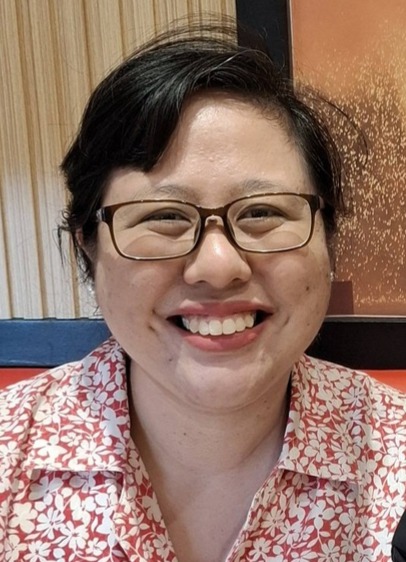
Gabi Francisco is a classically trained soprano who now performs in the English / Music / Drama classroom. On weekends she soaks in as much art and literature as she can, so she can pass her love for the arts on to her students. She passionately believes in the transformative role of arts education in nation-building. (IG: teacher.gabi.reads )

