
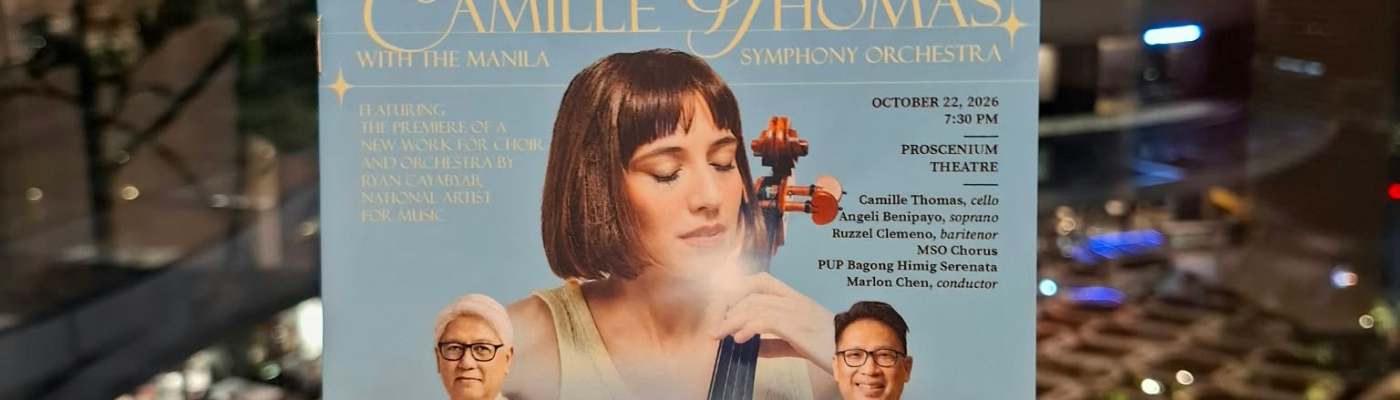
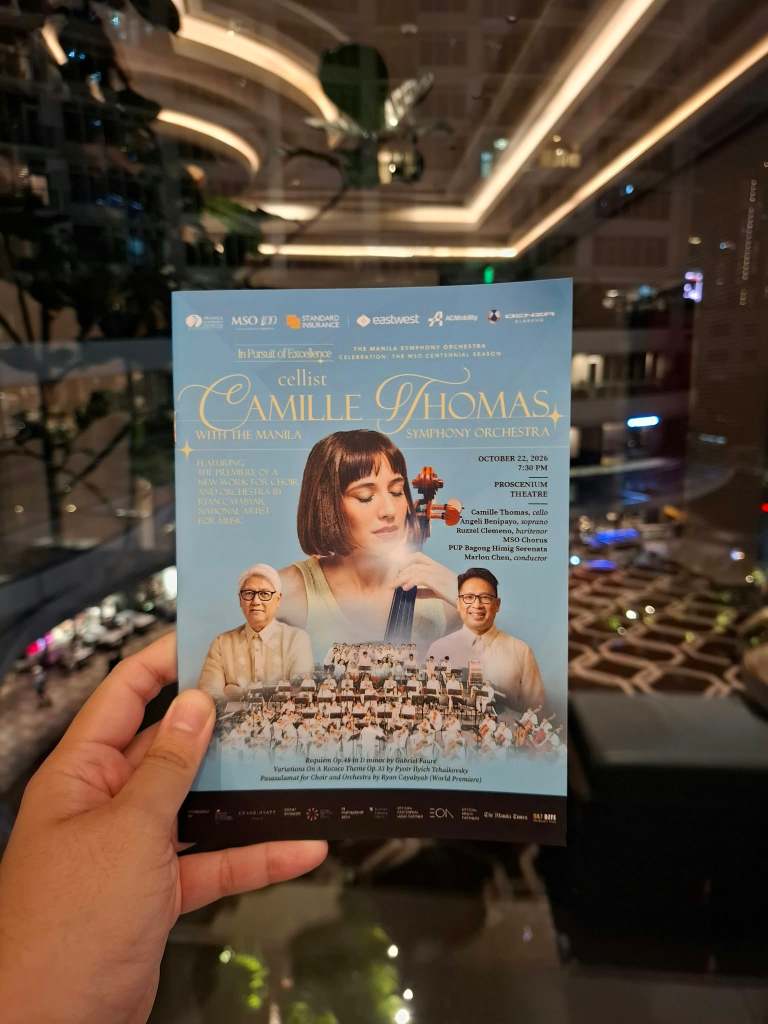
Nothing is more thrilling than being among the very first to witness the birth of a new piece. The seven National Artists in the sold-out audience on the evening of October 22, 2026, all agreed.
Even the addition of a high profile Franco-Belgian cellist such as Deutsche Grammophon artist Camille Thomas (as alluring and much appreciated as it is) could not detract from the main event: the chance to bear witness to the artistic child borne from the union of two National Artists (Ryan Cayabyab for Music and Virgilio Almario for Literature). Tonight was the birthday of their choral symphonic piece, Pasasalamat (Thanksgiving).
The Manila Symphony Orchestra’s fifth concert of its Centennial season was an evening of ambitious programming, with the evening’s offerings divided into three acts, all conducted by Marlon Chen. Fauré’s Requiem mass started us off on a somber note, then Camille Thomas played as cellist soloist in Tchaikovsky’s Variations on a Rococo Theme (Op. 33) as well as three encore pieces to thunderous applause. Lastly came the world premiere of Pasasalamat, both courageous and convention-defying.
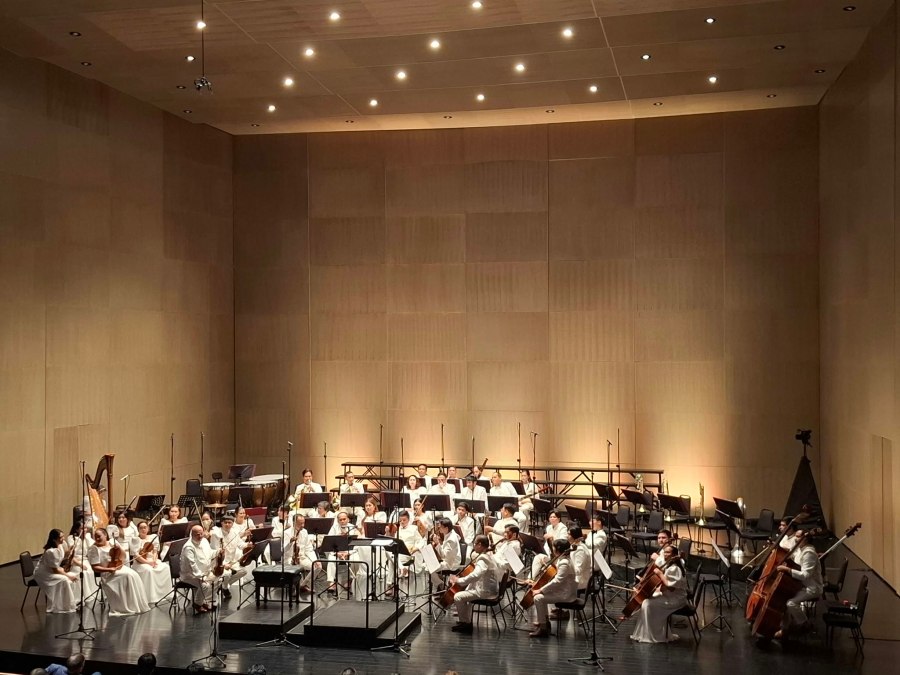
A Requiem as Homage to A Century of Musicians Gone Ahead
Fauré’s Requiem turned out to be a redacted, Dies Irae-less version of the afterworld, with seven movements that began with a repetitive melodic ostinato on the lower strings, reminding one of the heavy footsteps of a penitent dragged down by sin. Its second movement continued the heaviness, yet with more movement from violas and cellos: a soul searching for a foothold to ascend to Paradise.
In a blessed entrance of lightness, the first and second violins only come in on the third movement, along with the harp and massive horns announcing the triumphant Hosanna.
Of the two young soloists, soprano Angeli Benipayo was the more clearly heard, with her fresh rendition of Pie Jesu (perhaps the most famous movement from the Fauré mass) moving faster than the usual tempo in recordings, imbuing it more fully with vitality.
Baritenor Ruzzel Clemeno has improved by leaps and bounds from the last time we heard him sing in a Rossini opera, yet at times he was overpowered by both the choir and orchestra.
If we had been lulled into thinking salvation was guaranteed already by the peaceful fourth movement, the fifth and sixth still introduced fresh terrors, with blazing horns in minor passages, and the bass strings ever churning lower and lower even as the choir goes higher: a musical illustration of the soul’s journey despite the weight of sin. The triumph heard in Libera Me, with the martial rhythms, depict a battle won but not without cost. The young sopranos in the choir also labored hard to sustain their long phrases (not always perfectly) but the lightness of their tone brought much delight as we seemed to hear angels in their innocent voices.
Russian Melancholy Amid Mozartean Joy
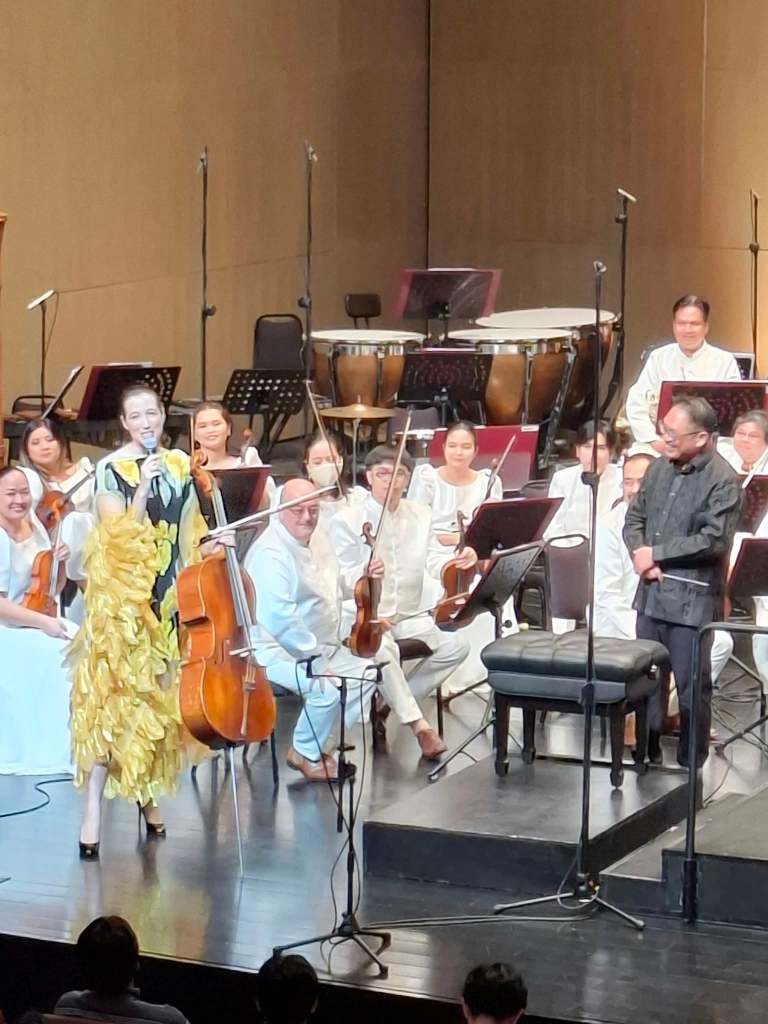
The Tchaikovsky Variations showcased Camille Thomas’ range very well, as it delivered both virtuosity in fast sections, and the plaintive sighs and weeping of the more mournful andantes. Thomas was both a delight to watch and listen to, her graceful arms an extension of her phrasework as she played a piece that started out very Mozartean, then became full on melancholic Russian towards the end (with portions reminiscent of Dark Eyes). It ended with the Nutcracker musical flavor that Tchaikovsky is famous for.
The crowd applauded so hard that Thomas was persuaded to play three crowd pleasing encores: Saint-Saëns’ The Swan, Bach’s Cello Suite No. 1 in G Major, and Casals’ cello arrangement of the Catalan carol, Song of the Birds. In The Swan, the piece could have done with more rehearsal on the part of the harpist, as Thomas visibly adjusted to her pace more than the other way around. The Bach was utterly lovely, but for this viewer, the musical highlight of the evening was the carol. Despite the joyful text of the folksong it was based on, Song of the Birds brought heartbreak to all who heard it. The music shows the inherent tragedy of the birth of an innocent babe doomed to die as the wage of humanity’s sins. It also provided a beautiful bridge to the last part of the evening, as Pasasalamat’s title also belied the controlled turmoil of the music it was set in.
Truth is Beauty, despite Unconventionality
Pasasalamat is possibly the farthest Cayabyab has strayed from conventional chords and harmonies. This is not the work of a master craftsman aiming to please his audience, but an artist imbuing his work with all the despair and turmoil of the past few years: Chaos embodied in chorales and made audible through near-atonality. One could say that it is truly contemporary, with melodic leaps and dissonances challenging its singers and instrumentalists alike.
From the very beginning, with the use of vibraphone, oboe and clarinet, and the minor key, we were jolted from our expectation of a straightforward thanksgiving.
It reminds one of the Book of Job, of the man deprived of everything, yet who still manages to give thanks.
The text itself begins with:
Ipagpasalamat natin paggising ang pagsikat ng araw
O kahit ang umagang umuulan
Dahil baka higit na marami ang nangangailangang
Puso, nilikha, at bukiring nauuhaw.
In “Iisa ang ating planeta,” heavy percussion and strident horns blared, a sonic warning of impending doom.
Steady war drums beat as the choir sang:
Laban sa agham na walang damdamin
Laban sa politikang walang simulain
Laban sa kaunlarang walang dangal
Laban sa sining at panitikang walang kabuluhan
Laban sa ligayang walang budhi’t hanggahan.
The piece is a musical manifesto, serving as both warning and encouragement. Chordal resolution comes only on endings of phrases, the rest can pass for the musical equivalent of noise. This is, after all, the truth of what it means to struggle for one’s humanity in these dehumanizing times.
As if to make amends for disturbing our ears and hearts (as they rightfully should be), the orchestra and choir performed the beloved Christmas song Kumukutikutitap as its final encore.
An Evening’s Legacy
From remembrance of past artists, to a celebration of the present, and a prayer for the future, this was a sonic journey to remember.
This century-old orchestra has survived world wars and a pandemic. With this evening’s incredible assemblage of performing powers (including a new choral find, the young voices of the PUP Bagong Himig Serenata), it seems that the future of the MSO is assured.
~ ~ ~
[The reviewer was given a complimentary ticket to watch the concert. It was held on October 22, 2026, at the Proscenium Theatre in Rockwell, Powerplant, Makati.]
ABOUT THE REVIEWER:

Gabi Francisco is a classically trained soprano who now performs in the English / Music / Drama classroom. On weekends she soaks in as much art and literature as she can, so she can pass her love for the arts on to her students. She passionately believes in the transformative role of arts education in nation-building. (IG: teacher.gabi.reads )

