

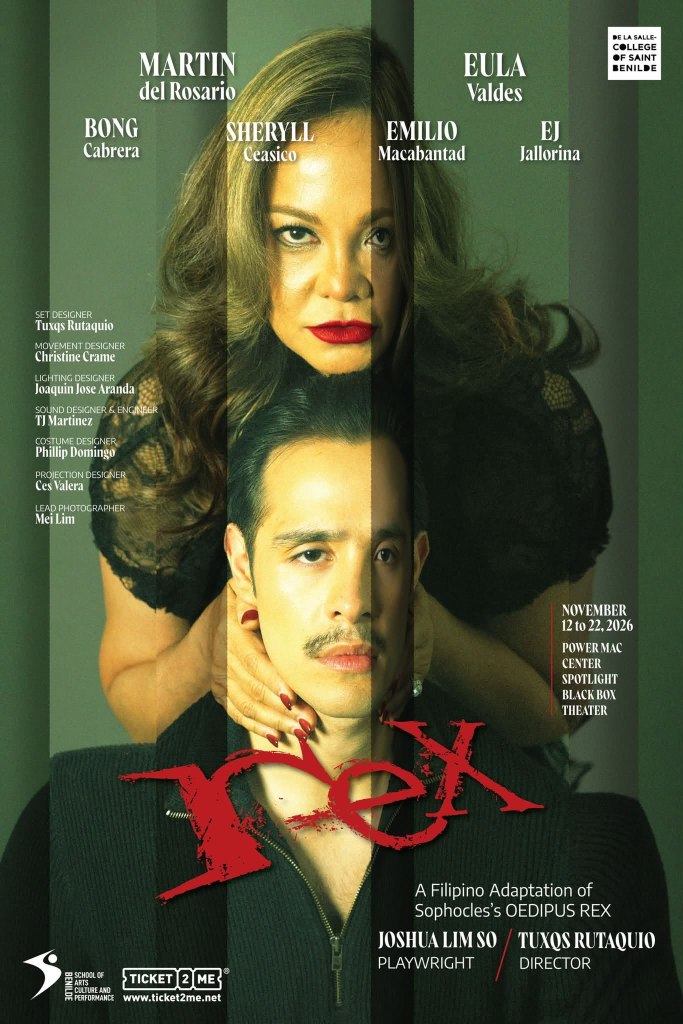
(Poster courtesy of De La Salle – College of Saint Benilde’s SACP)
Are we born free, or forever in the chains of fate? Perhaps no other play asks this immortal question better than Oedipus Rex.
It’s quite a challenge to perform a tragedy as (in)famous as this Sophocles play, one of the most studied in the canon, as it is a perennial curriculum filler of both high school and college English classes. The appeal of watching a show like REX lies in seeing how ancient tragedy is remade when transplanted in our country today.
De La Salle – College of Saint Benilde’s production is a Filipino “reimagining” of the original Greek play, written by award-winning playwright Joshua Lim So, and helmed by director and Chair of their Theater Department, Tuxqs Rutaquio. The cast and team included professionals amongst the school’s alumni, faculty, and current students.
Jean Cocteau said that Oedipus Rex is the theatrical equivalent of seeing a trap spring shut. In REX, the trap is a deluge that covers a corrupt politician’s entire family. Their golden cage is a mansion in a fictional Filipino province called Tebes, funded by flood control projects of their construction company.
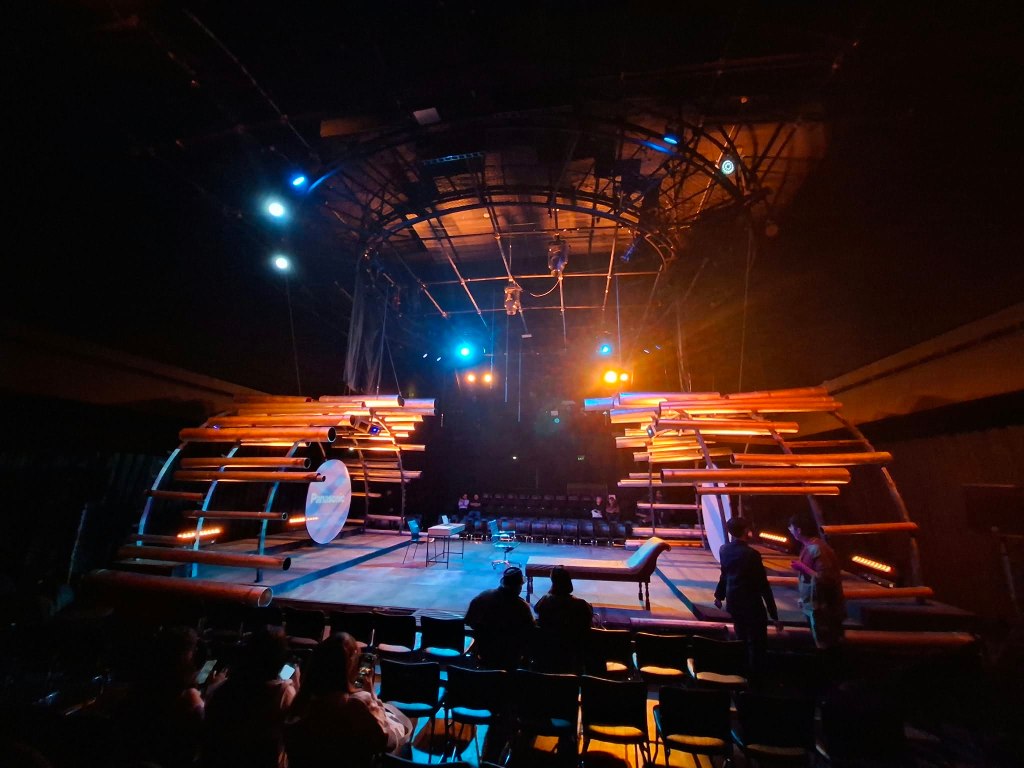
Audience members needed to make our way slowly and carefully to our seats, as the set took up a great deal of the center of the Power Mac Spotlight Theater. Long lengths of pipes and tubes were broken in the middle, where a desk and a Greco-Roman divan lay.
It begins with murder, as actor Martin del Rosario interrogates and shoots a suspected communist, bound and blindfolded. But before the crime, his victim utters a prophecy: he will be killed by his own child. Del Rosario presses the trigger just as his victim is about to give the name of his child.
In the next scene, del Rosario is still onstage, and yet he seems very different from the powerful killer in the scene that had come just before. He is less sure, somewhat more insecure. And then it dawns gradually: he is a different character. The casting choice to have the same actor portray two different (yet intimately connected) roles was a masterful stroke of foreshadowing, I thought.
The drama all takes place in one room, at the home of Eddie Po and his wife, Jacosta, portrayed by the beautiful Eula Valdes. In another brilliant piece of theatrical premonition mixed with actual real life practice, the playwright has the couple call each other “Ma” and “Pa.” To this audience member familiar with the tale, it’s enough to send chills down my spine.
For the uninitiated, the startlingly huge age gap between the two alluring main actors is enough to raise plot alarm bells. It’s big enough for this viewer to feel uncomfortable when they engage in marital intimacies onstage, which also leads to personal reflection on inherited attitudes, social norms, and taboos.
Eddie isn’t sleeping. The heavy rain isn’t helping. There’s a big problem at work and Jocasta’s brother, Creon (Bong Cabrera), comes over to help fix it. A newly installed Justice Secretary is demanding answers to a twenty-year-old mystery: who killed her brother, Mr. Leo Yu?
We are introduced to the children: two daughters and two sons, one of whom is disabled (another unsettling clue!). A daughter wants to go on an outing; Jocasta forbids her to go because the optics of resort hopping while everyone is under a state of calamity isn’t good for the family.
It’s the chilling scenes of warm family interactions that I’ll remember this play for. The director and playwright have made the hero a villain, but a sympathetic one. Eddie Po’s household could be any Filipino family. Jocasta could be any middle-aged matriarch, insisting on a narrative of “magaling gumawa ng paraan” when her children mention that others think they are “kurakot.”
The action unfolds swiftly, as a blind witness is called, shocking revelations are investigated, and lives are ruptured with a phone call. The expected end, when it came, fell a bit flat as there was a drawn out, challenging scene that would require all of a veteran actor’s artistic resources to do justice to. On the night I watched, Del Rosario seemed utterly emptied out and pitiful, a contrast to the Sophoclean hero who fights against the gods by making a terrible choice, the human embracing agency even in the face of utter despair. Eddie Po in Rex is a victim, punished for his crimes against the land and its people.
The strongest performances of the evening were those of Bong Cabrera as Creon, and EJ Jallorina as Teresa, the blind prophet/ess who is not all that she seems. They seemed the most authentic, their anger and passion closest in approaching the intensity that audiences expect when watching Greek tragedy.
We feel for the tyrant’s family, and this invites us to reflect on our own complicity in the corruption of our state, one we as a people allow. The play raises the question: Are we forever trapped in a destiny of our own making, of history repeating itself every election cycle? The tyrant in REX is punished by fate, but if we wait for Heaven to act in real life, it may be too late.
[The reviewer was invited to the press preview of Benilde School of Art, Culture, and Performance‘s REX. Tickets range in price from P2,000.00 to P2,700.00. They run until November 22, 2026, with shows at 2:00 PM and 7:00 PM at the Power Mac Center Spotlight Black Box Theater, Circuit, Makati.]
ABOUT THE REVIEWER:

Gabi Francisco is a classically trained soprano who now performs in the English / Music / Drama classroom. On weekends she soaks in as much art and literature as she can, so she can pass her love for the arts on to her students. She passionately believes in the transformative role of arts education in nation-building. (IG: teacher.gabi.reads )

